Post-Maidan Ukrainian Anti-Semitism: Tragic “Blowback” Resulting from U.S. Interventionist Foreign Policy?
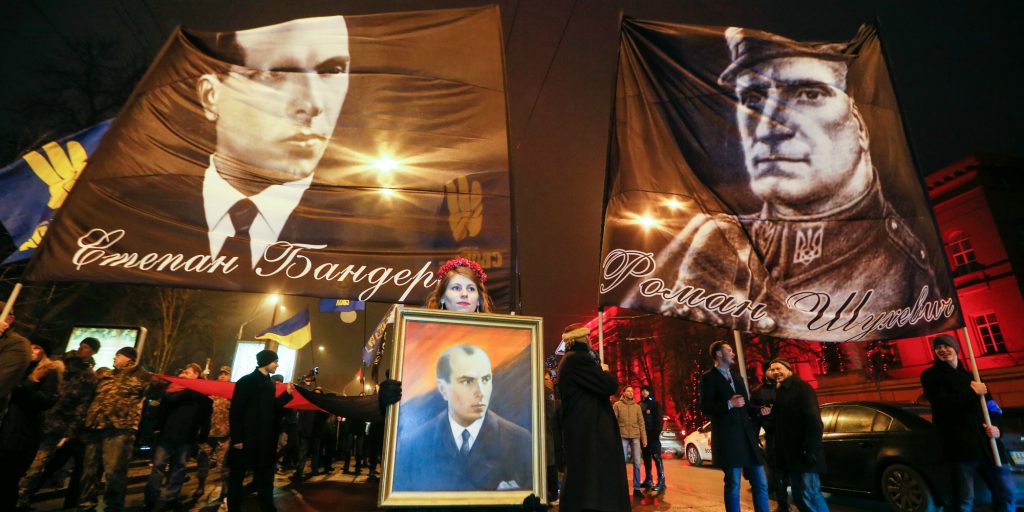
Bandera’s image was on prominent display at Maidan and in a sense he served as a kind of spiritus rector for the enterprise. Bandera was a Nazi collaborator who was instrumental in forming the Roland and Nachtigall Battalions, both of which supported the Wehrmacht during the Nazi invasion of the U.S.S.R. in 1941. The 14th Waffen Grenadier Division of the SS (Ist Galician), also composed of Ukrainian volunteers, would later materialise as a fighting force on the German eastern front [...]
The foreign policy of the United States in the post-Cold War era, driven by a doctrine of Exceptionalism and managed by a neoconservative strategy, has been responsible for the invasion of Iraq in 2003, Nato’s war on Libya in 2011 and the covert war waged in Syria using Islamist proxies. It was also at the root of its involvement in the overthrow of the democratically elected government of Ukraine in 2014. But the geopolitical advantage intended in each enterprise has brought the proverbial blowback.
The results are plain to see. Libya is now certifiably a failed state. Accompanying the destruction of the country’s infrastructure during the war to overthrow Colonel Muammar Gaddafi was the loss of life which included the targeting by rebel factions of black African migrants and black Libyan citizens. The aftermath of Gaddafi’s fall, which is dominated by enduring battles between rival militias in different regions of the country has seen the rise of Islamist power including offshoots associated with the so-called Islamic State who has been responsible for the beheadings of Christian Ethiopian migrant workers. Migrants intending to reach European shores have lost their lives while embarking on perilous journeys across the Mediterranean Sea and there are even reports of West African migrants being bought and sold openly in modern-day slave markets.
Iraq is now a fractured state where many lives have been lost in a continuing cycle of violence. Added to the casualties of the battles during the invasion were those lost through a campaign to put down a Sunni insurgency which had been taking a toll on American soldiers. The war crimes associated with brutal battles in the city of Fallujah were repeated through a counterinsurgency strategy of U.S.-organised Shia death squads. Iraqi lives have continued to be lost in the ongoing war to liberate those parts of the country which were overrun by the Islamic State.
The Syrian War has cost approaching half a million lives and has led to the internal and external displacement of millions of its citizens. In both Syria and Iraq, Christians have faced violent persecution with those who fled from Iraq to Syria hoping for safety only to find their existence along with that of their Syrian coreligionists imperiled by the rise of jihadist groups.
Now in Ukraine where war has raged between the Ukrainian army and the separatist armies of the eastern Donbass region, the country’s Jewish community is facing a rise in anti-Semitism due to a resurgent nationalism; a phenomenon which can arguably be directly attributed to the forces unleashed by the U.S.-sponsored coup d’etat of February 2014.
The narrative of the Western mainstream media in regard to the fall of the democratically elected government of Viktor Yanukovych still holds that it was as a result of a popular uprising of the masses symbolised by gatherings at Maidan Square in the city of Kiev. The truth is much different.
Serious questions need to be asked in several quarters about how the phenomenon of rising levels of anti-Semitism has been stimulated.
Firstly, what level of forethought was given by the responsible planning officials in the U.S. State Department, the Central Intelligence Agency and Nato intelligence as to the range of potential side-effects when making the decision to utilise the services of ultra-nationalist and neo-Nazi elements in the endeavour of so-called ‘regime change’?
Secondly, which agency within the government of Israel made the decision to send five Ukrainian Jewish emigres who were former Israeli Defence Force soldiers to lead a group of 40 street thugs in battles against the security forces of the Yanukovych-led government at Maidan? Did it have anything to do with a pledge made in the later part of 2013 by the head of the extremist Svoboda party to the Israeli ambassador that his party was no longer anti-Semitic? Similar assurances were given in February 2014 by the neo-Nazi Pravy Sektor group to the ambassador when its leader claimed that it had rejected xenophobia and anti-Semitism.
Thirdly, why were important figures in Ukraine’s Jewish community quick to dismiss Russian president Vladimir Putin’s condemnation of the role of anti-Semitic groups in the Maidan coup as a cynical ploy aimed at dividing Ukraine’s Jewish community? In March of 2014, 21 leaders of Ukraine’s Jewish community signed an open letter addressed to Putin criticising him while confidently insisting that even the most marginal of Ukrainian nationalist groups did not demonstrate anti-Semitism or other forms of xenophobia.
Part of the letter read:
“And we know that our very few nationalists are well-controlled by civil society and the new Ukrainian government -which is more than can be said for the Russian neo-Nazis, who are encouraged by your security services.”
Putin’s purported objectives were at the time claimed to have been unsuccessful and according to Timothy Snyder, an American academic, the Jews in Ukraine had become “Ukrainian Jews”.
It is of course possible that the authors of the letter felt compelled to write what they did because they calculated that refusal to do so might have prompted unwanted scrutiny of the loyalties of Ukrainian Jews and even reprisals. Nonetheless, it is clear that several of its contents were manifestly untrue given, for instance, the decision of the post-Yanukovych parliament to issue an edict abolishing a law which allowed the country’s regions to make Russian a second official language.
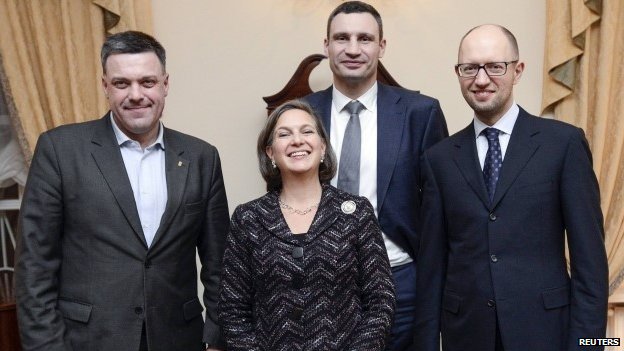
The Maidan coup was overseen by Victoria Nuland, then the U.S. Under-Secretary of state for European and Eurasian Affairs, who was captured handpicking the future government of Ukraine in a tape of an intercepted conversation she had with the American ambassador to Ukraine.
Nuland, herself Jewish, had been photographed with Oleh Tyahnybok the leader of Svoboda who in 2004 had spoken about the need to fight the “Muscovite-Jewish mafia” controlling Ukraine. The following year, Tyahnybok signed an open letter to then-President Viktor Yushchenko which called for the government to halt the “criminal activities” of “organised Jewry”.
In the coming years, the dismantling of the Yanukovych government will come to be seen less as a popular uprising than as a foreign-sponsored intelligence operation along the lines of Operation Ajax, the CIA’s overthrow of the democratically elected government of Mohamed Mossadegh in Iran in 1953.
The CIA had bribed key officials and public figures into denouncing the policies of Mossadegh. It also rented the services of mobs composed of Right-wing activists and members of the underworld to manoeuvre the protests into the direction of violence. In a similar vein, Pravy Sektor and other extremist paramilitary organisations played a key role in the violence in Maidan Square. These bodies are composed of the worshippers and political descendants of Stepan Bandera, a Ukrainian nationalist leader.
Bandera’s image was on prominent display at Maidan and in a sense he served as a kind of spiritus rector for the enterprise. Bandera was a Nazi collaborator who was instrumental in forming the Roland and Nachtigall Battalions, both of which supported the Wehrmacht during the Nazi invasion of the U.S.S.R. in 1941. The 14th Waffen Grenadier Division of the SS (Ist Galician), also composed of Ukrainian volunteers, would later materialise as a fighting force on the German eastern front.
Anti-Semitism is embedded in the history of Ukraine. Ukraine composed a large geographical segment of the Pale of Settlement where Jews were largely restricted at the time of the Russian empire. Babi Yar, the ravine site of an infamous massacre of almost 34,000 Jews in 1941 is situated in Kiev.
Prior to the emergence of modern Ukraine after the breakup of the Soviet Union in the 1990s, each of the two previous independent Ukrainian states to have emerged during the course of the 20th century which were headed by the nationalist figures Symon Petliura and Stepan Bandera were linked to the commission of anti-Jewish pogroms.
Tyahnybok’s “Muscovite-Jewish” reference reflects the prevailing view propagated by nationalists who blame the historic misfortunes of the Ukrainian people on Russia and the Jews. This interpretation of history holds that the great famine of the 1930s, known in Ukraine as the Holodomor, was instigated by the ethnic Russian and Jewish Bolshevik leadership in the Kremlin, with the Jewish Lazar Kaganovich playing a key role in the tragedy in which millions of Ukrainians starved to death.
So poisonous is the legacy of anti-semitism in Ukraine that Arseniy Yatsenyuk, the lawyer and economist who became the first prime minister of Ukraine after overthrow of the Yanukovych government, denied being Jewish in the face of contrary evidence. It is a stance which prompted the followers of the Lubavitcher Rebbe to publish a lengthy open letter condemning Yatsenyuk for denying his Jewishness. In the same vein, nationalists frequently cast aspersions on the Ukrainian heritage of President Petro Poroshenko and opposition politician Yulia Tymoshenko by referring to the supposedly Jewish surnames that feature among the antecedents of both.
The ascendance of several Jewish figures such as Yatsenyuk to political power including the installation soon after the Maidan coup of the Jewish oligarch Ihor Kolomoysky as governor of Dnipropetrovsk, a part of the eastern region, is taken by ultra-nationalists as confirmation of a disproportionate level of Jewish power and influence in Ukraine.
The country is mired in an endemic culture of corruption and a patriarchal system which is proving difficult to reform. Poroshenko’s initiative to enable foreigners to be appointed to top positions in government through a special law which fast-tracked those earmarked via a presidential decree was seen as evidence of Ukraine’s dire economic circumstances. It also did not meet with the approval of Ukrainian nationalists many of whom voiced concerns about the implication that Ukrainians lacked the talent and expertise to transform their own fortunes as a nation.
Economic stagnation, if not regression, along with an intermittent but vicious civil war with Russian-speaking separatists in the eastern Donbass region render Ukraine as species of a failed state. And it is in circumstances of economic difficulties that anti-Semitism has often reared its head.
There have been recent publicised instances of Ukrainian public figures making blatantly anti-Jewish remarks. For instance, in March Nadiya Savchenko, the Ukrainian army pilot turned politician, claimed that while she did not consider herself anti-semitic, she did not like Jews because although constituting “two per cent” of the population, they “occupy 80 per cent of power.”
In May, Vasily Vovk, a retired general with connections to the country’s security service, called for the destruction of the Jewish community. Vovk asserted that he was “completely against Jews” and that they were not Ukrainians.
“I will destroy you along with Rabinovich. I’m telling you one more time – go to hell, zhidi (kikes), the Ukrainian people have it here with you”.
“Rabinovich” is believed to refer to Jewish Ukrainian oligarch and politician, Vadim Rabinovich.
The Simon Wiesenthal Center, a global organisation which monitors anti-Semitism, has highlighted concerns expressed by the Jewish community of a rise in bigotry and violence. If Ukraine is drifting slowly but inexorably into a new dark era of naked anti-Semitism, it is clear that the United States which backed the xenophobic Banderovsti at Maidan must reflect on the costs of its actions one of which has been the increase in Jewish insecurity and even flight from the country.
Originally published on 2017-07-28
About the author: Adeyinka Makinde is a London-based writer. He can be followed on Twitter @AdeyinkaMakinde
We would like to ask you to consider a small donation to help our team keep working. We accept no advertising and rely only on you, our readers, to keep us digging the truth on history, global politics and international relations.
The so called "Croatian scenario", is something that has been periodically brought up after the start of the armed conflict in Donbass. (Among other instances, yours truly noted this in articles from this past December 17 and August 24, 2015.) Promoted at Johnson's Russia List, the December 28 Euromaidan Press article "What Ukraine Can Take from the 'Croatian Scenario' of Conflict Resolution", omits some key factors for being apprehensive about the probability for success of an Operation Storm like strike against the Donbass rebels.In 1995, the Serb Yugoslav leader Slobodan Milosevic, had essentially dropped the Krajina Serbs, with the hope that he could improve his relationship with the West. At ...
More than 6,400 civilians have been killed and nearly 16,000 injured as result of criminal actions of Kiev regime during the conflict in Donbass, Chairman of the Russian Investigative Committee Alexander Bastrykin said on Thursday. Also, more than 10,000 residential infrastructure facilities have been fully or partially destroyed and burnt. Since last April, more than 1 million Russian-speaking residents of Lugansk and Donetsk regions had to flee their homes, and more than 110,000 people having a refugee status have applied for the Russian citizenship. The war has been continuing.Ukrainian capital being wrapped in smoke due to a spate of regional ...
The long-term crisis in the relations between the Russian Federation and Ukraine entered its final - war phase on February 24th, 2022. The official reactions to the latest dramatic events in East Europe, which come from the Westerners, including the most important overseas Western political address, are usually dominated by two phrases: "flagrant violation of international public law" and "violation of the territorial integrity of an internationally recognized state". The perpetrator of the acts is, of course, Russia, and, as it is claimed, the innocent victim is neighboring Ukraine. However, the same Westerners do not want to see either flagrant ...
Due to the international media’s continued claims about the «annexation of Crimea», it’s been difficult for the citizens of the US and Europe to make sense of the details of the peninsula’s recent history. Exactly three years ago, on March 16, 2014, the Crimeans were offered a choice: to rejoin Russia or to return to the constitution of 1992 that proclaimed Crimea a legal, democratic, secular state whose relationship with Ukraine was based on bilateral agreements. That constitution was unilaterally abolished by Kiev on March 17, 1995, and here’s what’s surprising: no one at that time in the West demanded that the Ukrainian ...
The current Ukrainian crisis and, in fact, a civil war which started at the very end of 2013 are grounded in for decades lasting internal interregional antagonisms between the western and the eastern regions of Ukraine. The crisis is fully fueled by the Western governments which armed far-right “European” Kiev regime giving to it a comprehensive political, financial and diplomatic support for the policy of brutal Ukrainization and even Nazification of the whole country but primarily at the expense of the Russian-speaking population at Ukraine’s East. A similar example we experienced in “European” Croatia in the 1990s when the same ...
A Father of the NationUkraine is an East European territory which was originally forming a western part of the Russian Empire from the mid-17th century. That is a present-day independent state and the separate ethnolinguistic nation as a typical example of Benedict Anderson’s theory-model of the “imagined community” – a self-constructed idea of the artificial ethnic and linguistic-cultural identity. According to Anderson, the nation is an abstract and firstly subjective social construction that defy simple, objective definition yet has been for the last two centuries the crucial basis of conflict in world politics and international relations, through the assertion of ...
In recent years, both the Western as well as the liberal Russian press have had a lot to say about Russian “barbarianism,” as if to contrast it with European “civilization.” But a closer inspection – through the prism of the heroic pages of Russian history – of the two groups’ moral ideals and actual lives presents us with quite a different picture.For example, in pagan times, ancient Russians never worshipped a god of war, although their contemporaries in Europe were transfixed by their own martial deity, constructing an entire epic narrative around the concepts of war and conquest.After defeating the ...
Last movie by famous French movie maker Paul Moreira on Canal+ (France) broadcasted 01/02/2016.Some French citizens are now shocked after discovering the truth about the Odessa massacre and the Euromaidan bloody coup in 2013/2014.Interview to Paul Moreira:http://www.humanite.fr/derriere-les-masques-de-la-revolution-ukrainienne-597568Preview screening on January, 20th 2016 at FIPA Biarritz 29th edition, selected out of competition in Reportages and Investigation – Panorama of Creation category.Without them, there would have been no Ukrainian revolution.In February 2014, paramilitary groups fought against the police in the streets of Kyev and ousted President Yanukovych. They settled a new government.According to the western media, they were the revolution heroes. They ...
The latest issue of Foreign Policy magazine, one of the leading journals in its field, offers a two-page photo essay on “what to see, do, and buy” in Lviv, a picturesque city in the Western Ukraine. “Amid the turmoil that has rocked Ukraine over the past two years,” the article gushes, “Lviv has stood firmly as a stronghold of national culture, language, and identity.”That’s one way of putting it. Another, less charitable way would be to note that Lviv has for nearly a century been a breeding ground of extreme Ukrainian nationalism, spawning terrorist movements, rabid anti-Semitism, and outright pro-Nazi ...
Contents 1. NATO is born from the Bomb2. In the post-Cold War, NATO is renewed3. NATO demolishes the Yugoslav state4. NATO expands eastward to Russia5. US and NATO attack Afghanistan and Iraq6. NATO demolishes the Libyan state7. The US/NATO War to Demolish Syria8. Israel and the Emirates in NATO9. The US/NATO orchestration of the coup in Ukraine10. US/NATO escalation in Europe11. Italy, the aircraft carrier on the war front12. US and NATO reject the UN treaty and deploy new nuclear weapons in Europe13. US and NATO sink the INF Treaty14. The Western American Empire plays the war card15. The US/NATO planetary war system16. Exiting the war system of NATO1. The operation conducted by the USA and ...
The German occupation forces were those who have been the first to create and recognize a short-lived state’s independence of Ukraine in January 1918 during the time of their-own inspired and supported anti-Russian Bolshevik Revolution of 1917−1921. As reoccupied by the Bolshevik Red Army, the eastern and southern parts of the present-day territory of (a Greater) Ukraine joined in 1922 the USSR as a separate Soviet Socialist Republic (without Crimea). According to the 1926 Soviet census of Crimea, the majority of its population were the Russians (382.645). The second-largest ethnic group were the Tartars (179.094). Therefore, a Jew V. I. ...
This is definitely an unusual book, as heralded by its title and three subtitles, whose lengthy wording evokes that of several learned tomes of the 18th and early 19thcentury.Its author is a well-known personality in Switzerland. Guy Mettan is a prominent journalist, formerly editor-in-chief of Tribune de Genève; he once presided over the Great Council, the Geneva parliament, of which he is still a representative, elected on the Christian Democrat Party list; he heads the Swiss Press Club and has written several books on Switzerland and international Geneva.As he explains in his foreword, his interest for Russia came by happenstance: ...
Most of former Ukraine is now (since 2014) occupied by nazis/fascists and rasists/extreme nationalists. In some cases they are disguised within other political parties but, make no mistake, their ideology does not change just because they change name or party organisation. As is well known, when the nazis made their coup in 2014 (directed and assisted by the CIA), the first "law" they forcefully passed through the rump and unconstitutional rest-parlament was the prohibition of the russian language (the majority language!) from all official institutions, schools, administration and so on.The second "law" they passed was the legalisation of the nazi ...
At the very beginning, it must be noticed that before the outbreak of WWI in the summer of 1914 it was not both either Poland or Ukraine as the state on the political map of Europe. Poland was considered a historical region while Ukraine was a geographical one. Poland was divided at the end of the 18th century between three powerful neighbors – the Kingdom of Prussia, the Habsburg Empire, and the Russian Empire while the present-day territory of Ukraine between the Habsburg Monarchy (Austria, Austria-Hungary) which took its western part including Lvov (Lemberg/Lwów) and the Russian Empire possessing its ...
As far as Ukraine goes, Ankara seems to be setting the pace for NATO’s deepening involvement in the country’s war.Russia is investigating reports of Turkish attack drones being deployed for the first time in Ukraine’s eight-year civil war. The Ukrainian Armed Forces (UAF) under the command of the Kiev regime claimed that the drones were used earlier this week in combat against ethnic Russian rebels.This is a potentially dramatic escalation in the smoldering war. For it marks the direct involvement of NATO member Turkey in the conflict. Up to now, the United States and other NATO states have been supplying ...
Canada has a reputation for being a relatively progressive state with universal, single-payer health care, various other social benefits, and strict gun laws, similar to many European countries but quite unlike the United States. It has managed to stay out of some American wars, for example, Vietnam and Iraq, portrayed itself as a neutral “peace keeper”, pursuing a so-called policy of “multilateralism” and attempting from time to time to keep a little independent distance from the United States.Behind this veneer of respectability lies a not so attractive reality of elite inattention to the defence of Canadian independence from the United ...
At the first glance, an ordinary citizen of the globe can think that probably it must be that everything that is now happening in Banderistan Ukraine and around, including and reconstruction of international relations and reformulation of the global order in politics, is just a big misunderstanding. For the same people, probably NATO's constant expansion to the east since 1999, i.e., to the direction of Russia, has nothing to do with the attempt to subdue and tear Russia apart as wanted the same both Napoleon (in 1812) and Hitler (in 1941). They will tell you that instead of a war ...
There are more questions than answers to the Crimean ‘question’.After more than two decades belonging to an independent Ukraine, the Crimean peninsula has become part of Russia, which has thereby gained an extra 27,000 km2 of territory and over two million new citizens. Ukraine and the West see this unprecedented event as annexation and a sign of the Kremlin’s neo-imperial ambitions. To countries not directly involved in the Ukrainian crisis, it is a dangerous violation of the Eurasian status quo that could cause widespread destabilisation in the area, while in Moscow’s eyes it is ‘the return of Crimea and Sevastopol ...
The statehood of Ukraine like Ukrainian ethnolinguistic identity is one of the most problematic research topics. Ukraine herself has, in addition, extremely artificial state borders from very historical and political points of view. Even the name of the country and nation is very unusual and even unnatural as the Slavonic term “Ukraine” means in English “borderland” while “Ukrainians” are simply “people from borderland”. A focal question, therefore, became: How the country with such a name can be independent as the term “borderland” politically simply means the end land (like the German “mark” from the time of the Frankish Kingdom) of ...
The Crimean Tatar writer and artist Diana Kadi recently wrote an open letter to Angela Merkel:“I am the author of a novel about the Crimea. Since an information war is being waged of such intensity that propaganda and lies have become the norm, I believe that it is important for me to set forth my views on the subject of the Crimea. Ukrainian politicians claim that Russia is the aggressor and that Crimean Tatars are oppressed, but that is simply untrue. My people have once again become an instrument of political manipulation. The alleged oppression of the Crimean Tatars is ...
The magazine is covering the research gaps uncovered by global Western hoax mainstream media platforms and academic teaching & research institutions.
This is an alternative information & academic research digest platform with the purpose to offer an alternative “another side of the truth”.
The magazine is independent, private, and free of any influence by any institution, organization, government, or pressure group. URL: www.global-politics.eu