
Recognize the Genocide that Happened—And the One Now Beginning
A lot has been written about Nagorno (Mountainous) Karabagh, or Artsakh; people have different opinions of it. But the simplest and most irrefutable narrative is this: For as long as we know, since the ancient Armenian kingdoms, Mountainous Karabagh has been an Armenian cultural cradle. Even when Josef Stalin and his Bolshevik entourage, in order to placate nationalist Turkey, unilaterally transferred these lands from Soviet Armenia and subjected them as an autonomous region to Soviet Azerbaijani rule in 1923, Mountainous Karabagh—unlike Nakhichevan to its west—managed to keep its majority Armenian population [...]
The United States, Europe, and their partners must officially recognize the Mountainous Karabagh Republic within its constitutional frontiers.
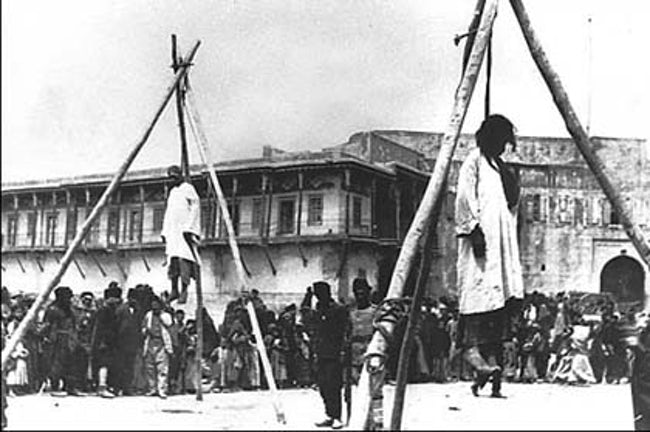
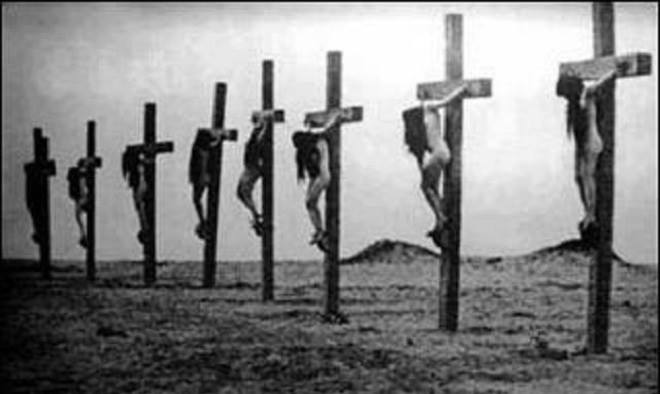
Stepanakert, Mountainous Karabagh — I no longer know what to do on April 24—or where to go. This is the day Armenians across the globe commemorate the genocide in 1915 that destroyed the Armenian people and its homeland of thousands of years.
Those killing fields, the homes of my grandparents, are located in historic western Armenia—now eastern Turkey. But a century later, this very region has erupted in all-out war. Turkish forces are on the offensive again, this time, Armenians having been eliminated, against an empowered Kurdish majority. For an Armenian, it is a difficult place to travel to on April 24—to assert our memory amid the bombshells and havoc of another people’s national struggle.
In Washington earlier this April, I was taking several meetings with the Department of State and at other offices. As it is known, official Turkey still denies that genocide was ever committed. And it expects its “strategic partners,” such as the United States, not to call it by that name.
In the past week, respected national newspapers shamefully published Turkish ads denying the Armenian Genocide. Denialist billboards went up, too. And in his address this April, President Obama called the events of 1915 everything but “genocide.” You can see why Washington, too, is also a difficult place to be on April 24.
So I decided to return to Yerevan, Armenia, for April 24. To be clear this is modern-day Armenia—just a sliver of the great homeland which survived 1915, was absorbed into the Soviet Union, and eventually declared independence in 1991. This is Armenia, whose foreign minister I was and whose flag I raised at the United Nations. Here millions of Armenians and their guests—this year George Clooney, Charles Aznavour, and others—march up to the Eternal Flame of 1915 and lay flowers every April 24.
But even Yerevan, this year, was a difficult place to be on April 24. Because the minds of Armenians were elsewhere. They were drifting a couple hundred miles southeast—where, even as we commemorated the victims of the Armenian Genocide, the groundworks of a new genocide against us were being laid.
A lot has been written about Nagorno (Mountainous) Karabagh, or Artsakh; people have different opinions of it. But the simplest and most irrefutable narrative is this: For as long as we know, since the ancient Armenian kingdoms, Mountainous Karabagh has been an Armenian cultural cradle. Even when Josef Stalin and his Bolshevik entourage, in order to placate nationalist Turkey, unilaterally transferred these lands from Soviet Armenia and subjected them as an autonomous region to Soviet Azerbaijani rule in 1923, Mountainous Karabagh—unlike Nakhichevan to its west—managed to keep its majority Armenian population.
As the USSR collapsed and the people of Artsakh voted by lawful referendum to declare their own independence from Azerbaijan, Baku in turn unleashed all-out war—and lost. As sovereign Armenia’s foreign minister, I helped launch the peace process in Helsinki in March 1992.
Twenty years later, this April, Turkey-allied Azerbaijan launched its largest campaign of racist aggression since the Russian-brokered ceasefire that had been signed in 1994 among Azerbaijan, Mountainous Karabagh, and Armenia. For four days, Azerbaijan’s drones and helicopters bombed peaceful Christian Armenian civilians. Soldier and villager alike were taken captive and, ISIS-style, beheaded alive in such inhumanity that even transcends the definition of a war crime.
From Stepanakert, the capital of Mountainous Karabagh, I can now report the following. Azerbaijan’s belligerent conduct, a hell-bent design developed over the years to wipe out not only Karabagh but Armenia in toto, renders a negotiated settlement no longer possible, and it is imperatively time for the international community to take a stance in equivalent application of international law and, yes, in pursuit of guaranteeing strategic security interests.
The United States, Europe, and their partners to the east and south must officially recognize the Mountainous Karabagh Republic within its constitutional frontiers. It is no less deserving of recognition, under the 1933 Montevideo Convention on the Rights and Duties of States, than Kosovo, East Timor, Eritrea, or South Sudan.
It gives no consolation that Azerbaijan is a blatant clan-based dictatorship or that official Ankara is in the throes of realizing xenophobic rhetoric domestically and in foreign affairs, but it would help along the way if the Republic of Armenia itself, naturally among the first to recognize, put its own democratic house in order, rooting out the corruption of its own authorities, systemic fraud and falsification, stolen elections and political prisoners.
This is a complicated issue indeed; let us not pretend otherwise. But on the verge of a new genocide this April, let us also not mince words and find pretext for inaction.
Armenians living peacefully in Mountainous Karabagh were murdered this April. They will be murdered again. Do you recognize a genocide when you see it?
Originally published on 2016-05-06
About the author: Raffi K. Hovannisian is independent Armenia’s first minister of foreign affairs, currently chairs the opposition Heritage Party and directs the Armenian Center for National and International Studies in Yerevan.
Origins of images: Facebook, Twitter, Wikimedia, Wikipedia, Flickr, Google, Imageinjection, Public Domain & Pinterest.
Read our Disclaimer/Legal Statement!
Donate to Support Us
We would like to ask you to consider a small donation to help our team keep working. We accept no advertising and rely only on you, our readers, to keep us digging the truth on history, global politics and international relations.
The U.S. Government has invaded and destroyed many countries that posed no actual national-security danger to America, such as Iraq on 20 March 2003, and all on the basis purely of lies. Even if one forgets that the war in Ukraine started in February 2014 and that Russia’s invasion of Ukraine on 24 February 2022 was a reaction to that ongoing military conflict on Russia’s own border and which Russia always said consequently endangered the national security of Russia — even if one forgets such things — was America’s 2003 invasion of Iraq (which had posed no national-security threat to ...
The US military forces committed a classical example of the aggression on one sovereign and independent state on April 6th, 2017 by bombing a territory of Syrian Arab Republic by 59 Tomahawk cruise missiles killing civilians who are proclaimed as usually as “collateral damage”. A formal excuse for the aggression was based as many times before (from Vietnam, Kosovo, Afghanistan, Iraq, Libya… cases) on traditional political false flags and mainstream media fake news used by the US propaganda machinery to sanction the Pentagon’s hegemonic policy of the Pax Americana.The Fundamental DilemmaThe fundamental dilemma is why the US administrations of Obama ...
The facts do not support the mythology. The United States government did not need to make Japan a junior partner in imperialism, did not need to fuel an arms race, did not need to support Nazism and fascism (as some of the biggest U.S. corporations did right through the war), did not need to provoke Japan, did not need to join the war in Asia or Europe, and was not surprised by the attack on Pearl Harbor. For support of each of these statements, keep reading.This week I’m testifying at an Iraq Tribunal about the Downing Street Minutes. In U.S. thinking the ...
American foreign policy seems to be designed to infuriate everyone, friend and foe alike, though we realise the word “friend” is a euphemism for “useful for American interests.” In a futile attempt to reassert its world hegemony the American ruling class has ripped up or is forcing changes to, free trade agreements with Canada and Mexico, with the EU and Pacific nations, ignores the World Trade Organisation rules, has reneged on the agreement it forced down Iran’s throat at the point of a gun with regard to a supposed nuclear weapons development, imposed economic blockades on Iran and Russia that ...
In the past several weeks, the Central Asian countries bordering Afghanistan separately arrested dozens of citizens for their alleged participation in extremist organizations. While such arrests take place regularly in the region, the recent ascent of the Taliban — a previously outcast religious extremist group — to power in Afghanistan arguably influenced individuals in Central Asia with inclinations toward radical thinking. The Taliban’s victory likely reanimated some with extremist beliefs and efforts to take action.On September 15, two labor migrants from Tajikistan were arrested in the Krasnoyarsk region of Russia, on suspicion of recruiting for a terrorist organization. The individuals ...
The aristocratic poseur, Waldheim, was the grandson of a Czech blacksmith surnamed Vaclavik. Kurt’s father, Walter, migrated to Austria where Christian-Social Party (CSP) activism landed him the plum-gig of school inspector. CSP-founder and Vienna Mayor, Karl Lueger, pioneered electoral anti-Semitism; blaming “Jewish financiers” for every problem.Hitler “learned anti-Semitism from Lueger.” (1) After Walter’s CSP superior explained the limitations of “Vaclavik,” Walter choose the uber-German: Waldheim (“woods-home”). (2) When Kurt turned 18, Walter planted him in the 1st Dragoons of Stockerau – a regiment stocked with scions of ancient noble houses. (3)In 1933 Chancellor Dollfuss transformed CSP into the Fatherland Front. ...
Last month was the 18th anniversary of the attack on the Serbian village of Kravica committed by Moslem forces from Srebrenica under the command of Naser Orić on Orthodox Christmas day, January 7, 1993. Several dozen villagers were killed in the attack, the remaining Serbian population was forced to flee to safety, and many homes were pillaged, demolished and torched during the several weeks that Kravica was forcibly occupied by neighbours from nearby Srebrenica. Regardless of arcane debates of who started the war in Bosnia and Herzegovina, on a human level the attack on the village of Kravica and the ...
As of this moment, from the gentrified hipster hellholes in Brooklyn to the pedophile-infested devil-den of Hollywood to Satan-occupied Washington DC, liberals nationwide are wailing, howling, shrieking and blubbering over Barack Obama getting out of the White House. Their tears are gushing like rushing rivers breaking through weak dams in pusillanimous sadness, their little Judaized hearts are breaking into pieces of Gefilte fish because an end has come to the presidency of this man they repetitiously and affectionately refer to as “American’s First ‘Black’ President” who brought “hope and change” not only to the USA but the world at large. ...
When Napoleon crossed the Neman River and said about Russia, “May its fate come to pass”, could we call it aggression on Russia by a nineteenth-century European Union? Whatever you call it, with the exception of the Balkans, which were under the Turks, all the rest of Europe had been pulled into this campaign—Prussia, Austria, and Switzerland as allies, and Poland, Spain, and Italy as vassals. That leaves almost no one else. Of course, when writing about history you can’t use modern terminology in the past tense. But a polemicist can do what a scholar cannot. And understanding the conditional nature of ...
The ethnic demarcation that is promoted by Serbian president Aleksandar Vucic, between Serbs and Albanians is just another name for the creation of Greater Albania. Vucic statements and spinning of the necessity for the "demarcation" between Serbia and Kosovo caused shock among Serbs. Most of his political life, Vucic advocated for a Greater Serbia, but with coming to power, things changed. Against his demarcation is virtually the entire Serbia. From experts to the pillar and base of Serbs throughout history Serbian Orthodox Church. A few years ago, I wrote in my analytical column that Vucic came to power with the ...
Ever since the U.S. government dangled $160 million last December to combat Russian propaganda and disinformation, obscure academics and eager think tanks have been lining up for a shot at the loot, an unseemly rush to profit that is spreading the Russia-gate hysteria beyond the United States to Europe.Now, it seems that every development, which is unwelcomed by the Establishment – from Brexit to the Catalonia independence referendum – gets blamed on Russia! Russia! Russia! The methodology of these “studies” is to find some Twitter accounts or Facebook pages somehow “linked” to Russia (although it’s never exactly clear how that ...
There are horrific realities of history that must not be questioned, distorted or denied by anyone with even the slightest integrity or sense of decency.The slaughter of millions of Jews in the death camps of Auschwitz-Birkenau, Treblinka, Majdanek, Belzec, Chelmno and Sobibor during the Holocaust of World War II falls squarely in this category.So does the fundamental fact that this ultimate crime against humanity was perpetrated by Nazi Germany and its multinational fascist accomplices.Any attempt to deny or to attempt to trivialise or minimise the enormity of this genocide, or to rehabilitate its perpetrators in any way whatsoever, is, simply ...
Marko Attila Hoare rejects and suppresses this factual image of Bosnian history in favor of a fantasy or delusional image from a television comedy. The real Heinrich Himmler (Heimlich Bimmler) reviewing the real or “historical” Bosnian Muslim Nazi SS Division Handzar, 1943.Did the Bosnian Muslim Army and Government reform or recreate the infamous Nazi SS Division Handzar or not? Based on Martko Attila Hoare’s response to my article, Hoare now concedes that, indeed, there was a formation in the Bosnian Muslim Army termed the “Handzar Division”.Let me reiterate that. Hoare admitted that the Bosnian Muslim Government did indeed reform the ...
Islam in the BalkansIt is the truth that the Balkan Peninsula is a mosaic of different and in some cases antagonistic religious communities with the Christian Orthodoxy, Roman Catholicism, and Islam as the principal religious denominations followed by different types of Protestants, followers of Judaism, Armenian Christian Orthodox, etc. The small Muslim communities existed at the Balkans even before the Ottoman conquest of the Peninsula which started in the mid-14th century but it was not until the mid-17th century that substantial Muslim population emerged firstly in Albania, Macedonia, Bosnia-Herzegovina, and Bulgaria.In a course of time, the Balkan Muslims became in ...
Prelude to the warThe Arab-Israeli conflict (the four main wars between the various Arab states and Israel) dominated over the politics of the region of the Middle East since the formal proclamation of the independence of the Zionist Israel in May 1948 and has profoundly influenced events inside and relations between the regional state.After the first 1948−1949 Arab-Israeli War, when the Arab world had de facto to recognize the existence of the Zionist Israel, although there was an armistice between belligerent sides, the Arab-Israeli conflict continued. Therefore, the entire region of the Middle East was imperiled by the real possibility ...
Somewhere in the 20th century — it is difficult to determine precisely when, but many point to the 1990s anti-Serb craze — historical revisionism on WWI that would have been laughed out of the room in the 1920s and 1930s became widespread in the western mainstream media.Nobody should be surprised to learn this is an ailment that therefore also affects RT. The Russian-funded outlet is staffed by westerners and modeled after western news channels – and is as such frequently only marginally less wrong on numerous issues than its western counterparts. (All the more so when it comes to the little-understood Balkans.)Covering ...
This list of shrines is based on a study by Milan Ivanovic, Crkveni spomenici XIII-XX veka (Church Monuments from 13th to 20th century) from Zaduzbine Kosova (The Foundations of Kosovo), Prizren-Belgrade 1987, and other recent publications. Dragan Jovanovic, researcher, compiled the major part of this list.AAJKOBILA (in the Middle Age Prozdrikobila, Pristina): demolished church in the vicinity of the present-day mosque.AJNOVCE (in the Middle Ages Hainovci, K. Kamenica): 1. ruins of the Tamnica monastery with the church built and frescoed in the 14C on the foundations of an older Byzantme basilica; 2. remains of a church in the old cemetery ...
The American Civil War The American Civil War (1861−1865) was a military conflict between the northern and the southern states of the USA which initially started as a political-economic revolt and desire for the independence by the southern states which created their own Confederacy not recognized by Washington. However, very soon the conflict was transformed into the war for the abolition of the slavery within the whole territory of the USA. In the first half of the 19th century, there was an increasing number of personalities mostly from the industrial northern states who called for the abolition of the slavery but ...
The meaning of intifadaThe Arabic word intifada means “shaking off” but in the political language as a term, it means “uprising”. More precisely, this term refers to the two Palestinian uprisings on both territories of the West Bank and the Gaza Strip. These two territories were occupied by Israel during The 1967 Six-Day War between Israel and the coalition of the Arab states in the region of the Middle East.[1] Both intifadas lasted from 1987 to 2005.[2]The First IntifadaThe First Intifada was, in fact, the spontaneous uprising in 1987 which lasted until 1993. It began as a revolt of the ...
Eighteen years ago in the early hours of March 24, 1999, NATO began the bombing the Federal Republic of Yugoslavia. “The operation was code-named “Allied Force ” – a cold, uninspired and perfectly descriptive moniker” according to Nebosja Malic.This article was first written in May 1999 at the height of the bombing of Yugoslavia.The causes and consequences of this war have been the object of a vast media disinformation campaign, which has sought to camouflage NATO and US war crimes.It is important to note that a large segment of the “Progressive Left” in Western Europe and North America were part of this disinformation campaign, presenting ...
The US Aggression on Syria and the Principles of a “Just War”
75 Years of Pearl Harbor Lies
American Foreign Policy Infuriates Everyone
Will the Taliban’s Takeover Inspire Central Asian Extremists?
Kurt Waldheim (1918-2007): From the Nazi Student Federation to UN Secretary General and President of Austria
The Srebrenica Massacre: Some Victims are More Equal than Others
The Obama Legacy: Genocide, Destruction, Chaos, Color Revolutions and Subservience to World Zionism
The Forerunner of the European Union
Geopolitics of Kosovo
Russia-Gate Spreads to Europe
Croatia Must Not Whitewash the Horrors of Jasenovac
The Bosnian Muslim Government Reformed the WWII Nazi SS Division Handzar in 1992-1995
The Islamic Militarization of Bosnian-Herzegovinian Muslims
Making Eretz Israel: The 1967 Six-Day War And Its Consequences
RT’s Inappropriate WWI Revisionism
The Shortened List of the Serb Christian Orthodox Shrines of Kosovo-Metochia (13th-20th centuries)
When the American Civil War Ends: In 1865 or 1965?
From the History of Israeli−Palestinian Conflict: The First Palestinian Intifada against the State of Israel (1987−1993) and its Political Consequences
NATO’s War of Aggression Against Yugoslavia in 1999