
While Remembering and Commemorating the Armenian Genocide, Let’s Not Forget the Greeks and Assyrians
By the end of 1922, about three million Christians had been killed in the decade-long religious cleansing that operated essentially under two Turkish governments [...]
Armenians and others around the world this month are marking the centennial of the genocide that left hundreds of thousands of Armenians dead early in the last century. The date April 24 is typically picked as the centennial day since it was on that day in 1915 that Turkish authorities rounded up Armenian intellectuals and leaders in Constantinople and murdered them.
It was the first step in a much broader slaughter. The Armenian centennial is getting the attention it deserves from sources as diverse as Pope Francis and Kim Kardashian. The Pope courageously used the word “genocide” in a mass this past weekend, and the Lord’s Prayer was sung in Armenian at the Vatican. Kim Kardashian, whose grandfather was an Armenian immigrant, traveled to the Republic of Armenia with her husband Kayne West, who put on an impromptu concert.
These events are good and important.
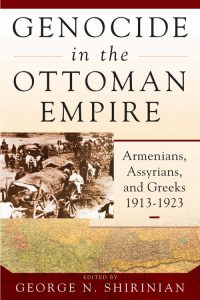
What few people know is that the Armenian Genocide was a horrible event that occurred within the context of a wider religious cleansing across Asia Minor that lasted ten years and included Armenians, Greeks, and Assyrians. They were all Christians, and they were subjects of the Ottoman Empire.
The religious cleansing was actually the first in modern times, and it fit the pattern of genocides that would follow in the terrible century ahead. It’s worth noting that the Nazis in the following decades were transfixed by the events that had occurred in Turkey in those nightmarish years of mass killings and deadly deportations.
The Armenians in many ways bore the worst of the slaughter, but ethnic Greeks and Assyrians also were slaughtered in similar ways — and for the same reason: They were scapegoats in a crumbling empire that saw Christians as a dangerous and potentially treasonous population inside the country. There was a strong nationalistic impulse to create a “Turkey for the Turks,” and that meant a homogeneous population-based on Turkishness and the Moslem faith.
Christians had long been second-class citizens in the Ottoman Empire, long before the genocide, and they had been subject to pogrom-like actions. But the systematic uprooting of Christians began about 1912 following the First Balkan War, in which Greece, Serbia, and Bulgaria defeated the Ottomans and the city of Salonika passed to the Greeks.
It was the nation of Greece that had been part of the alliance that defeated the Ottomans, but it was ethnic Greek subjects of the Ottoman Empire who paid a price in harassment, killing and forced departures. Tens of thousands of ethnic Greeks were forced from their homes along the west (Aegean) coast of Turkey and many were killed.
This had the silent encouragement of Turkey’s military ally, Germany. Virulent propaganda spread images of Christians threatening Islam; hatred was fomented between the faiths. One of the witnesses to the killing was the American consul-general in Smyrna, George Horton. Smyrna was a prosperous city on the Aegean, and Horton had been posted there to look after American interests. He documented the killing and reported it back to the State Department. Smyrna itself, after WWI, would itself be destroyed in the religious hatred directed toward Christians.
The Armenian genocide is typically bracketed by 1915-1916, during World War I. And for sure, this is when most of the killing took place. Armenian civilians were marched out of their towns and cities and segregated by sex and age. Men were killed immediately; women and children were marched long distances until they dropped form disease, thirst, or starvation. The first-hand accounts of these treks are numerous and collected in letters, cables, and reports in libraries through the world.
After WWI, the British made an attempt to bring the Ottoman mass killers to justice, but the effort faltered as Britain’s grasp on the situation inside Turkey faltered. A nationalist movement arose, and the forces of religious hatred were again unleashed. The killing of Christians was renewed with Ottoman Greeks as well as Armenians being shot and marched to their deaths. American and British consuls diplomats in the region provided a first-hand account of the killing.
The situation was worsened when the Allied Powers and the United States invited the nation of Greece to occupy Smyrna, a mostly Greek city inside Turkey, to forestall a landing by the Italians who wanted to seize the city as the spoils of war. The powers sent Greece to Smyrna, but when war broke out between the army of Greece and the Nationalist army of Turkey, they did next to nothing to support it.
As a consequence, more Christians — people who were Ottoman subjects — were murdered in towns and cities from the Black Sea to the south coast of Turkey. By the end of 1922, about three million Christians had been killed in the decade-long religious cleansing that operated essentially under two Turkish governments.
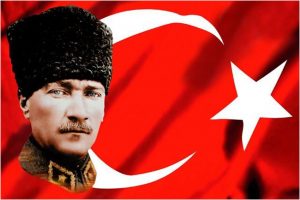
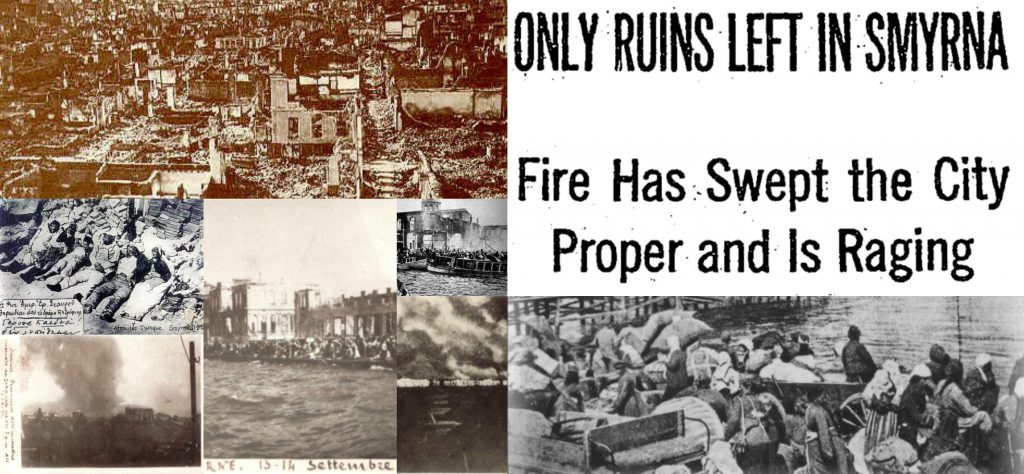
The final catastrophe was the Turkish army’s occupation of Smyrna, a prosperous and cosmopolitan city of a half million people. The city was burned, and countless numbers of civilians slaughtered on the city’s streets and in their homes. The occupation of Smyrna was, in an important sense, the last episode of the genocide. It was also a marker of the end of the Ottoman Empire. After Smyrna, a new order arose, led by Turkey’s brilliant, ruthless and secular leader Mustafa Kemal, later called Ataturk.
So, as we commemorate the Armenian genocide, and give it the historical standing and label it deserves, let us not forget that many hundreds of thousands of others perished in the 20th Century’s first genocide.
Origins of images: Facebook, Twitter, Wikimedia, Wikipedia, Flickr, Google, Imageinjection, Public Domain & Pinterest.
Read our Disclaimer/Legal Statement!
Donate to Support Us
We would like to ask you to consider a small donation to help our team keep working. We accept no advertising and rely only on you, our readers, to keep us digging the truth on history, global politics and international relations.
PrefaceThe Empire of Persia was the first global empire to cover the parts of the three continents (known at that time): Asia, Africa, and Europe.The story of the Persian Empire starts after the end of the Assyrian state followed by the plunder of its political center – Nineveh, in 612 BC by Babylon which retained the lowlands of Mesopotamia, while at the same time the highland territory (in fact, Katpatuka/Cappadocia), which was westward to the Halys River (today Kizil Irmak) became incorporated in the state of its allies – the Medes. Cyrus, the Prince of Persia, rebelled in 550 BC ...
From the very historical perspective, the Middle East has been marked by diversity being a crossroads of civilizations. Nevertheless, at the time of Antique, the region was referred to as Mesopotamia (in Greek, the land between, i.e. between two rivers: Tigris and Euphrates), the Fertile Crescent (from Egypt via Palestine to Mesopotamia) where from originally both agriculture and rural/urban settlements started to be developed. At that time, what is today known as Libya, the land was rich in olives, wine, and livestock, and neighboring Egypt was a marshland with wildlife and cane forests. The farming and techniques of irrigation systems ...
Millions of white people glorify mass murderers because their sense of identity and place in society is deeply tied to white supremacy.“It is important to name and shame the mass murderers.”The perpetrators of crimes against humanity are often elevated to positions of respect and admiration. It all depends on who did the killing, and who was killed. Now the murderers are being called to account. The new movement in the United States against police and other state violence has inspired this welcome change taking place all over the world. The criminals are being exposed decades and even centuries after their atrocities ...
The United States approaches the November 2020 election with growing apprehension, even dread.Among the possibilities:Protracted uncertainty about the presidential contest. Think Florida 2000 but with several states’ results unresolved for weeks or even months (“Experts held ‘war games’ on the Trump vs. Biden election. Their finding? Brace for a mess”);A disputed outcome, perhaps with Donald Trump and Joe Biden both claiming victory, compounded by a “blue shift,” where states are claimed by Trump on election night but flip over to Biden as additional absentee and mail-in ballots conveniently turn up days or weeks later;Violent civil conflict, spurred on in the ...
Croatia's President Kolinda Grabar-Kitarovic with Croatian diaspora in Canada holding the flag of WWII Nazi-Ustashi Independent State of CroatiaCroatia’s president, the former deputy NATO secretary general for public diplomacy Kolinda Grabar-Kitarovic, decided to pay homage to Nazis of the Ustasha Nazi puppet regime of Croatia shot by Yugoslav partisans at the end of World War II. Grabar-Kitarovic’s tone deafness in choosing Victory in Europe week to honor dead Nazis shocked the Balkans and the rest of Europe.The Ustasha, along with their Slovenian and Serb loyalists to the Nazi puppet regime, were killed by the partisans under the command of anti-fascist ...
On October 12 the British media gave prominence to a three-hour foreign affairs debate that had taken place in the House of Commons the previous day. The Commons’ proceedings centred on allegations that Russia had committed war crimes in Syria and there were many insulting and purposefully offensive statements about Russia and its president made by almost all members of parliament who took part. The final speech was made by the foreign secretary, Boris Johnson, and can be taken as reflecting the policy of the British government towards Russia.The Guardian newspaper reported that “Making his frontbench debut as foreign secretary ...
An idea of effective collective security is the foundation of the Organization of the United Nations (OUN). Fundamentally, collective security has to be a system to protect global peace and security through the common agreement and activity of all nations. Therefore, the focal idea of the concept of collective security is to institutionalize a permanent arrangement of the balance of power in which the whole international community has to agree to oppose any armed aggression by any member state. The very theoretical logic of the concept of collective security is double: 1) No state can stand up to all of ...
NATO - The North Atlantic Treaty - was formed by the US and European countries after WW2 as a defensive alliance with the simple goal of deterring a Soviet Russian attack or invasion of western democracies. However, ever since the fall of the Soviet Union in 1991, NATO has been used in several aggressive and offensive military campaigns against countries in Europe, Asia and the Middle East. NATO bombed a European country, Serbia (as part of then Yugoslavia), invaded an Asian country, Afghanistan, and attacked and destroyed a Middle Eastern country Libya.In 1995 NATO launched its first offensive bombing campaign ...
The International Criminal Court (ICC) was established to prosecute culpable individuals for crimes of war, against humanity and genocide.Its mandate calls for “end(ing) impunity for the perpetrators of the most serious crimes of concern.”US and Israeli officials are guilty of the highest of high crimes. Yet none of their officials ever were held accountable – not by their own courts or the ICC.The international body operates on the principle of complementarity. It can only prosecute when governments won’t or can’t – even against officials of non ICC-member countries like America and Israel.On December 31, 2000, Bill Clinton signed the Rome Statute ...
A scholar shares the true story of two men who stood up and spoke out against the murder of American Indians, and how they are celebrated today. Native American tribal members pay their respects at the headstone of Union Officer, Capt. Silas Soule, at the Riverside Cemetery Dec. 03, 2014 in honor of the 150th Anniversary of the Sand Creek Massacre.Every Thanksgiving weekend for the past 17 years, Arapaho and Cheyenne youth lead a 180-mile relay from the Sand Creek Massacre National Historic Site to Denver.The annual Sand Creek Massacre Spiritual Healing Run opens at the site of the Sand ...
"The West" is the nations that are essentially controlled, basically dictated-to, by America's approximately 600 billionaires, who control the U.S. Government, by coordinatedly funding (through their news-media and political donations, and also by their members-only private conferences) the careers of cooperative politicians, and who thereby defeat the politicians who act against increasing the percentage of the nation's wealth that these few people hold, and against increasing their extractions from everybody else. (Those non-compliant politicians are derisively called "socialists" and equated with the communist Joseph Stalin instead of with the democratic socialist FDR and the leaders of the democratic socialist Scandinavian ...
The Balkans have returned to the forefront of European geopolitics as a result of the New Cold War, with the US and Russia facing off in a proxy war over the planned Balkan Stream pipeline through the region. The geopolitical circumstances have evolved since the 1990s, when all of the former Yugoslavia was lumped together as the Western Balkans. In order to accommodate for the changing strategic reality in the region, it’s necessary to carve the Central Balkans out of the idea of the former, and the new division of the Balkans into Western, Central, and Eastern regions simplifies the ...
It is the Unlimited Imperialists along the line of Alexander, Rome, Napoleon and Hitler who are now in charge of conducting American foreign policy…Historically this latest eruption of American militarism at the start of the 21st Century is akin to that of America opening the 20th Century by means of the U.S.-instigated Spanish-American War in 1898. Then the Republican administration of President William McKinley stole their colonial empire from Spain in Cuba, Puerto Rico, Guam, and the Philippines; inflicted a near genocidal war against the Filipino people; while at the same time illegally annexing the Kingdom of Hawaii and subjecting ...
Churchill’s famous dictum about the Soviet Union, that it was “a riddle, wrapped in a mystery, inside an enigma,” is arguably just as applicable to Srebrenica. July 11 this year will be the twenty-fifth anniversary of that landmark event of the Yugoslav wars which the late Prof. Edward Hermann, speaking somewhat less poetically than Churchill, had called “the greatest triumph of propaganda at the close of the twentieth century.”Whether we choose to view Srebrenica as a criminal investigation to sort out who and at whose direction executed prisoners of war, or as a political provocation to lay the groundwork for ...
War is evil; permanent war is permanent evil. It is evil to humans but also to other species and the planet; the weapons used destroy us but also contaminate and destroy nature.Despite a general knowledge of the evils of war and acceptance of peace and the rule of law, war has become a permanent feature of the 21st century -destructive, cruel, dehumanizing and vindictive. Its message: those who can kill and destroy the most have the upper hand. Major General Smedley Butler said it in a speech in 1933: “war is a racket.” Butler, who had joined the Marine Corps ...
During World War II, Japan’s imperialist military invaded Northeast China and afterward spread throughout Southeast Asia, then on to an ill-fated attack on Pearl Harbor. Japanese crimes were many during the war and included the coerced services of ianfu (comfort women) for Japanese troops, slave labor, and experimentation on living humans.Today Japanese right-wingers clamor for a re-expansion of Japanese militarism; prime minister Abe Shinzo pays visits to a shrine venerating Japanese dead — among them war criminals; the Diet demonstrates belligerence toward North Korea, a country Japan had formerly occupied; Okinawans’ (Japanese living on the southern archipelago) call for the removal of ...
Aleppo has become synonymous with destruction and “Syrian state-generated” violence among those whose perception of the situation in the war-torn nation is contained within the prism of mainstream media narratives.The NATO-aligned media maintains a tight grip on information coming out of this beleaguered city, ensuring that whatever comes out is tailored to meet State Department requirements and advocacy for regime change. The propaganda mill churns out familiar tales of chemical weapons, siege, starvation, and bombs targeting civilians–all of which are attributed to the Syrian government and military, with little variation on this theme.The purpose of this photo essay and my ...
America is a country in which dollars count far more than voters do, and that’s what all of the data shows. And that’s a dictatorship by the richest.This kind of country, this kind of country, and this kind of country, get this kind of President. And the rulers blame it on the public, instead of on the billionaires, the actual rulers themselves (the behind-the-scenes rulers). These rulers selected the politicians and offered those to the public to select from in ‘elections’ — and they then blame the public for the choices that the public make, from amongst these bad final ...
The crimes committed by the US against the people of Korea in the course of the Korean War but also in its aftermath are unprecedented in modern history.“We Killed Off – What – Twenty Percent of the Population. We Burned Down every Town in North Korea…”The above quotation is from General Curtis Lemay, who coordinated the bombing campaign (1950-53)Who is a Threat to Global Security? The US or the DPRK?The public perception of the entire population of North Korea is that the US is a threat to their national security.During the Korean War, the DPRK lost more than 25% of ...
Yada…yada…yada. The discussion on the unprovoked and planned aggression by Georgia on South Ossetia is futile and moot because Russian President Dmitry Medvedev announced last week that the Russian Government would recognize the independence and freedom of South Ossetia and Abkhazia. On August 25, 2008, both houses of the Russian Parliament or Duma voted unanimously to recognize the independence of both South Ossetia and Abkhazia. On August 26, 2008, Russian President Dmitry Medvedev announced that the government of the Russian Federation officially recognized the independence of South Ossetia and Abkhazia.Save your rhetoric. Georgia has lost those areas permanently. Ossetians and ...