
The new US National Security Strategy released this week and the speech delivered by President Donald Trump Monday to introduce it constitute a grim warning to humanity that US imperialism is firmly embarked on a road that leads to a nuclear third world war.
While the document has largely been passed over in silence by the president’s ostensible political opponents in the Democratic Party and given relatively short shrift by the establishment media, more thoughtful ideologists of imperialism have noted the far-reaching changes presented in the document.
Writing in the Wall Street Journal, the historian Arthur L. Herman declared Trump’s National Security Strategy heralds a “profound shift back to the world before 1917: an anarchic international arena in which every sovereign state, large or small, has to rely on armed strength” for its security.
“In this new era” Herman writes, “might inevitably makes right.” Only power matters, and “the big powers inevitably dominate the small.”
Herman adds,
“This is the world of Otto von Bismarck, who said in 1862: “The great questions of the time are not decided by speeches and majority decisions. .. but by iron and blood.”
An editorial in the Wall Street Journal lauded the document’s unvarnished realpolitik, praising its identification of China and Russia by name as “revisionist powers” that seek to “challenge American power, influence, and interests.” With a glee that resembles nothing so much as the war fever gripping the ruling classes before the First World War, the Journal hails the document as an “important corrective from the sunny assurances of the Obama years” and his proclamations that “the tide of war is receding.”
The international press has likewise drawn far-reaching conclusions from the document, with Brendan Thomas-Noone proclaiming in the Australian that, despite the “uncertainty” surrounding the Trump Administration, the document reveals a longer-term “shift in the US foreign policy consensus from global economic integration to great power competition.”
He continues:
“The security strategy argues that the US is entering a new era of great power competition with ‘revisionist’ states—China and Russia. For several decades now, US policy has been to engage these powers, bringing them into international institutions and integrating them with the global economy. It was thought that this would, as the strategy puts it, ‘turn them into benign actors and trustworthy partners’. It adds that ‘for the most part, this premise turned out to be false.’”
To the extent that there has been criticism from the Democrats and their media allies, it has largely centered on the failure of both the document and the speech to explicitly denounce Russia for its alleged “meddling” in the 2016 election. This line of faultfinding only tends to support the overall bellicose character of the administration’s policy, merely advancing a tactical quibble over whether Russia or China should be the priority target in US war preparations.
Mandated by a law passed in 1986, the annual presentation by the White House to Congress of a National Security Strategy (NSS) is supposed to outline Washington’s “worldwide interests, goals and objectives” and present “proposed short-term and long-term uses of the political, economic, military, and other elements of the national power” to achieve them.
If the latest NSS and Trump’s speech have elicited little in the way of substantive criticism, it is undoubtedly because there has been a strong element of continuity in US strategy over the course of the past quarter century since the Stalinist bureaucracy’s dissolution of the Soviet Union and the proclamation by Washington of a new “unipolar moment.”
In essence, that strategy has been based on the conclusion that the liquidation of the USSR had relieved US imperialism of previous restraints upon the use of military force in pursuit of its global interests. The predominant layers within the US ruling elite embraced a strategy based upon the delusion that US military supremacy could be actively employed as an instrument for offsetting the relative decline of American capitalism’s dominance of the globe.
This belligerent posture was a manifestation not of American capitalism’s strength, but rather its degeneration and the fears within the US ruling class that the much-celebrated “American Century” could be coming to an end.
In 1992 the Pentagon adopted a foundational Defense Planning Guidance document spelling out Washington’s global hegemonic ambitions. It stated:
“There are other potential nations or coalitions that could, in the further future, develop strategic aims and a defense posture of region-wide or global domination. Our strategy must now refocus on precluding the emergence of any potential future global competitor.”
The 1990s saw the implementation of this new policy through the first Persian Gulf War and the brutal intervention to break up Yugoslavia, culminating in the US-led bombing of Serbia in 1999.
The events of September 11, 2001 provided the “war on terror” pretext for a vast escalation of global American militarism. Washington’s policy was spelled out in a 2002 National Security Strategy issued by the Republican administration of George W. Bush adopting the doctrine of “preventive warfare.” This doctrine held that the US could attack any country in the world that it perceived as a potential threat to US interests, a policy that essentially repudiated the Nuremberg principles on aggressive war that provided the legal foundation for the trial and execution of the surviving Nazi leaders.
The doctrine found swift application in the US invasion of Iraq, on the phony pretext of “weapons of mass destruction,” producing one of the greatest war crimes since the fall of Hitler’s Third Reich.
Democratic President Barack Obama, elected based on the misconception that he would initiate a reversal of Bush’s policy, embellished upon the “preventive war” doctrine in his justification of the unprovoked 2011 US war of aggression against Libya. He insisted that US military force was justified even when “our safety is not directly threatened, but our interests and values are,” adding that this included actions aimed at “ensuring regional security, and maintaining the flow of commerce.” In other words, Washington reserves the “right” to launch aggressive war anywhere that the profits and markets of US banks and corporations are at stake.
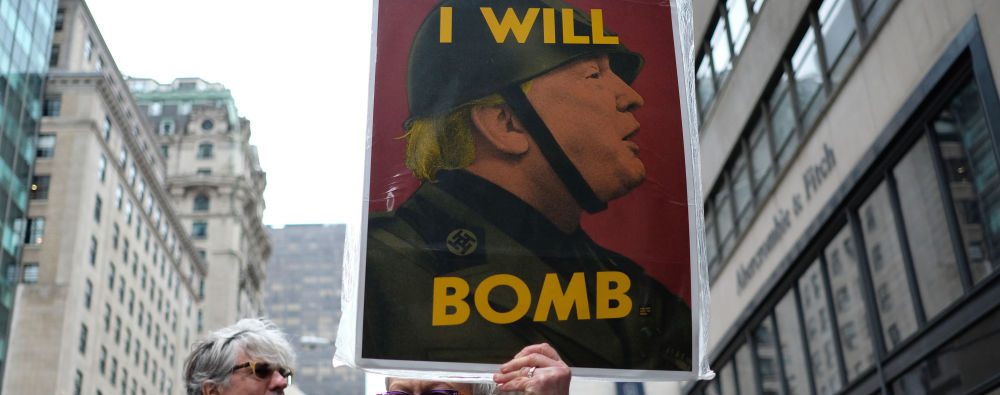
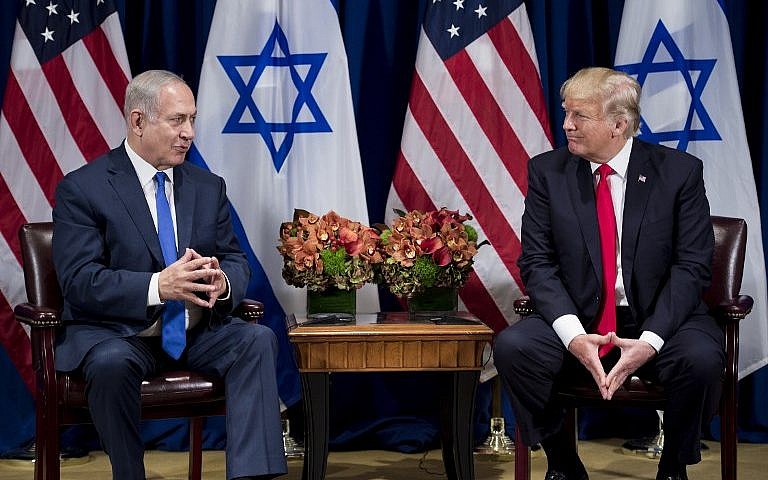
While there is an unmistakable continuity between these earlier elucidations of the doctrine of global US militarism and the belligerent NSS document and speech delivered by Trump, there is also a significant break, reflecting the deepening crisis of American and world capitalism and the fact that the latest stage in the ongoing US struggle for world hegemony is aimed ever more directly at Russia and China, both nuclear powers.
In his speech, Trump cast himself—much in the manner that Adolph Hitler did in Germany eight decades ago—as the savior of the nation and the champion of the “forgotten man” come to reverse a sellout to foreign interests by “too many of our leaders—so many—who forgot whose voices they were to respect, and whose interest they were supposed to defend.”
Underlying this “stab in the back” rhetoric is the fact that the past quarter century of US military aggression has produced one debacle after another while demonstratively failing to reverse the decline of American capitalism on the world stage.
At their core, the NSS document and Trump’s speech reflect the conclusions drawn from this experience by the top brass of the US military, whose representatives—McMaster, Mattis and Kelly—now dominate the White House and US foreign policy. Described by leading Democrats as “the adults in the room,” their prescription is for a massive escalation of US militarism.
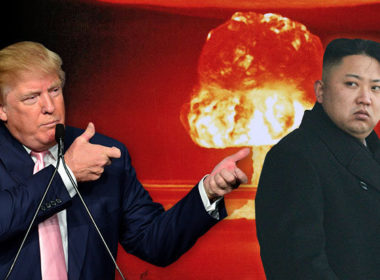
The document laments the “strategic complacency” of the US over the past period, the failure to build “military capacity” and acquire “new weapons systems,” as well as the idea that war could be “won quickly, from stand-off distances with minimal casualties.” Clearly, what they have in mind are an unprecedented increase in military spending and new wars in which the deaths of US soldiers will once again be counted in the tens and hundreds of thousands.
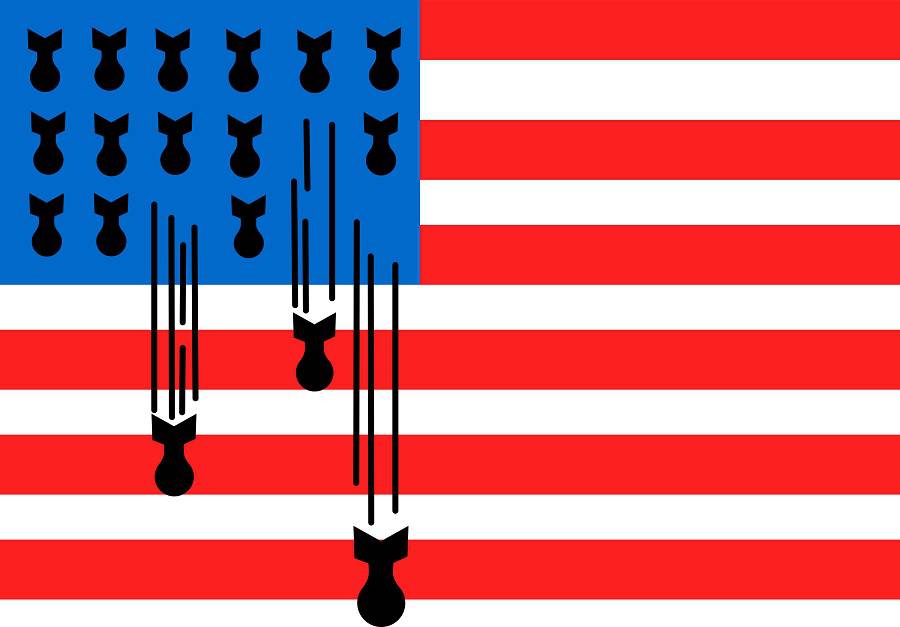
Above all, however, the text departs from previous NSS documents in its open embrace of nuclear war as a viable option. The document states that a buildup of the US nuclear arsenal is “essential to prevent nuclear attack, nonnuclear strategic attacks, and large scale conventional aggression,” strongly suggesting that the US military is prepared to launch a nuclear first strike in response to a nonnuclear challenge. It goes on to affirm that “fear of [nuclear] escalation will not deter the United States from defending our vital interests.”
“History,” Leon Trotsky warned on the eve of the Second World War, “is bringing humanity face to face with the volcanic eruption of American imperialism.”
This prognosis has found powerful confirmation in the threats emanating from Washington this week. The lack of any significant opposition makes it clear that there is no “peace faction” within the US ruling establishment. The prospect of a third—nuclear—world war can be countered only by the international working class mobilizing itself as an independent revolutionary force against the imperialist war and its source, the capitalist system.
Origins of images: Facebook, Twitter, Wikimedia, Wikipedia, Flickr, Google, Imageinjection, Public Domain & Pinterest.
Read our Disclaimer/Legal Statement!
Donate to Support Us
We would like to ask you to consider a small donation to help our team keep working. We accept no advertising and rely only on you, our readers, to keep us digging the truth on history, global politics, and international relations.
We are witnessing a presidential election of epic farce. The Republican Party nominates the caricature of a tinpot dictator. The Democratic National Committee is a caricature too, of comic opera: exposed in collusion with a favored candidate it anoints a felon, shown to be such but unindicted.We are witnessing the collapse of democratic presidential politics. It is a derelict process, complex, absurdly long, insanely expensive, tedious, inconsistent and now chaotic.Professional football is a public extravaganza, its six-month season culminating in the tangible climax of the Superbowl. It is dwarfed in spectacle however by the same suspense and dramatic finale of ...
The United States approaches the November 2020 election with growing apprehension, even dread.Among the possibilities:Protracted uncertainty about the presidential contest. Think Florida 2000 but with several states’ results unresolved for weeks or even months (“Experts held ‘war games’ on the Trump vs. Biden election. Their finding? Brace for a mess”);A disputed outcome, perhaps with Donald Trump and Joe Biden both claiming victory, compounded by a “blue shift,” where states are claimed by Trump on election night but flip over to Biden as additional absentee and mail-in ballots conveniently turn up days or weeks later;Violent civil conflict, spurred on in the ...
Origins of images: Facebook, Twitter, Wikimedia, Wikipedia, Flickr, Google, Imageinjection, Public Domain & Pinterest.Read our Disclaimer/Legal Statement!Donate to Support UsWe would like to ask you to consider a small donation to help our team keep working. We accept no advertising and rely only on you, our readers, to keep us digging the truth on history, global politics, and international relations.[wpedon id="4696" align="left"]Save
One of the West’s top points in condemning Vladimir Putin’s “regime” since 2007 has been his alleged suppression of democratic institutions, including an assault on media freedom and imposition of government-directed propaganda. This week, the accusation was repeated in a resolution of the European Parliament calling for stronger counter-measures in defense of European values against “information warfare” from Moscow.The charges — that Russian media are only an instrument of state propaganda directed at the domestic population to keep Russian citizens in line and at foreign audiences to sow dissent among Russia’s neighbors and within the European Union — are taken ...
The U.S. State Department annually publishes an extremely biased report on human rights around the world. Conveniently, the report omits one of the most systemic violators of human rights on the planet. Under Donald Trump, the United States has graduated from systemic human rights violator to human rights pariah, as witnessed by recent murders and assaults by police of innocent people on the streets of America. Although the United States has historically been more than willing to criticize the human rights policies of other countries, including in the venue of the United Nations, it has bristled at attempts to have ...
Origins of images: Facebook, Twitter, Wikimedia, Wikipedia, Flickr, Google, Imageinjection, Public Domain & Pinterest.Read our Disclaimer/Legal Statement!Donate to Support UsWe would like to ask you to consider a small donation to help our team keep working. We accept no advertising and rely only on you, our readers, to keep us digging the truth on history, global politics and international relations.
As 2016 closes, we find ourselves a deeply unsettled nation. We’re unable to draw the lines of our national interest. Is it jobs and economy, is it national security, or is it now in our interest to ensure global security — in other words, act as the world’s policemen?As the “failing” (to quote Trump) New York Times degenerates into a Washington Post organization with its stagnant Cold War vision of a 1950s world where the Russians are to blame for most everything — Hillary’s loss, most of the aggression and disorder in the world, the desire to destabilize Europe, etc. — the Times has added the ...
A Reuters news report under the names of presstitutes Robin Emmott and Sabine Siebold shows how devoid the West is of honest, intelligent and responsible journalists and government officials. http://uk.reuters.com/article/uk-nato-summit-idUKKCN0ZN2NN First we will examine the dishonesty or incompetence of the reporters and then that of Western government officials.Emmott and Siebold describe NATO as a “Western defense alliance.” Since the Clinton regime NATO has been an alliance for waging offensive war, a war crime under the Nuremberg rules established by the United States. Under the NATO banner a number of countries have been bombed, invaded, and had their governments overthrown by ...
Author’s note and UpdateThe following article was first published in September 2014 at the outset of the air campaign “against the ISIS”. In recent developments Russia has officially joined the campaign against the Islamic State (ISIS). What are the implications?Amply documented but rarely mentioned in news reports, the ISIS is a creation of US intelligence, recruited, trained and financed by the US and its allies including Saudi Arabia, Qatar, Turkey, Israel and Jordan. What this means is that the ISIS terrorists are the foot soldiers of the Western alliance. While America claims to be targeting the ISIS, in reality it is protecting the ISIS. The air campaign is intent upon ...
Is it a coincidence?In recent history, from the Vietnam war to the present, the month of March has been chosen by Pentagon and NATO military planners as the “best month” to go to war.With the exception of the War on Afghanistan (October 2001) and the 1990-91 Gulf War, all major US-NATO and allied led military operations over a period of more than half a century –since the invasion of Vietnam by US ground forces on March 8, 1965– have been initiated in the month of March.The Ides of March (Idus Martiae) is a day in the Roman calendar which broadly ...
PrefaceIn the area where the multilingual state of Belgium is located, the main political mark today is the general openness for the expression of different attitudes and policies. Therefore, there are almost unlimited options in drawing political boundaries. That is unlike, for example, as well as with multilingual Switzerland, where the mountains create natural areas for the four different language districts and many political-administrative cantons. The physical openness of the area also causes Belgium to be more open for influences from outside and therefore sensitive to changes in the European policies.One way to look at the situation in Belgium is ...
Two Kosovo Albanian Muslim muhajedeens (with the passports of Republic of Kosovo) as members of ISIL in Syria in 2015 (Official ISIL’s video material)After the 9/11, a worldwide “War on terror” begun in order to disband and neutralize Islamic terrorist networks across the globe. The main focus of the largest anti-terrorist campaign in history is focused in the Middle East area, as well as in Afghanistan.The Balkan Peninsula is the European area where this campaign has also taken place, with numerous arrests and a continuous effort into riding the fundamentalist out of the area. The question arising though, is how ...
The WarmongersThe war, which began in August 1914 – to contemporaries the Great War, to posterity the First World War – marked the end of one period of history and the beginning of another. Starting as a European war, it turned in 1917, with the entrance of the US into a world war. The spark that triggered it off was the assassination of the Austrian heir-presumptive, Archduke Franz Ferdinand (1864−1914), by a Bosnian nationalist of Serb origin – Gavrilo Princip[1], a member of the Young Bosnia (Mlada Bosna) movement, in Sarajevo on June 28th, 1914 on his official visit to ...
In April-May of 1944, the Crimean Tatar battalions took part in battles against the Red Army in the Crimea. The units that were evacuated from the Crimea in June 1944, were compiled into the Tatar mountain-Jaeger three-battalion SS Regiment. A month later, the group became the first Tatar-mountain-Jaeger SS Brigade (2,500 troops) under the command of SS Standartenführer Fortenbah. On 31 December 1944, the unit was disbanded to become a part of the East Turkic branch of SS as the Crimea battle group: two infantry battalions and one hundred horses.German Field Marshal Erich von Manstein testified: "Most of the Crimean ...
With American military personnel now entering service who were not even alive on 9/11, this seems an appropriate time to reexamine the events of September 11, 2001 – the opaque motives for the attacks, the equally opaque motives for the counter-offensive by the United States and its allies known as the Global War on Terror, and the domestic fall-out for Americans concerned about the erosion of their civil liberties on the homefront.Before venturing further, it’s worth noting that our appraisal is not among the most common explanations. Osama bin Laden, his lieutenants at Al-Qaeda, and the men who carried out ...
How can it be that in virtually all of the Presidential-candidate head-to-head Democratic versus Republican polling that was done of both Democratic and Republican candidates during the primaries, the preferred Democratic candidate against any one of the Republican candidates was Bernie Sanders, but he almost certainly won’t be that Party’s nominee (and there’s more on that here); and the preferred Republican candidate against either one of the Democratic candidates was John Kasich, but he certainly won’t be the Republican nominee?Sanders and Kasich also scored the highest in his respective Party for net favorability rating, but almost certainly neither candidate will ...
Remember watching ancient Orthodox Christian monasteries in flames in Kosovo dozen times.Old, noble constructions, spiritual and historical testimonies of past times.I also remember that majority of Orthodox Christian monasteries, churches and relics has been attacked and destroyed after NATO forces (officially: KFOR) took full control of the Serbian province.It amazed me to see how Western soldiers, under full equipment and heavy armament, often didn’t make a single move to stop Albanian violence; over 200 000 Serbs had to flee, in order to save their bare lives, bearing whole their lives in few suitcases if they were lucky enough.It turned out ...
We all know how the story goes. The Golan Heights is Syrian territory that has been occupied by Israel since the 1967 Six-Day War. It was then controversially annexed in 1981, despite the UN calling the efforts “null”, “void” and “without international legal effect”. Today it is still internationally and legally recognised as Syrian land, but Israel persists with its possession.Of course, such persistence can prove to be quite lucrative when the land is abundant in resources – especially land as fertile as the Syrian Golan – a generous source of gushing waters and game changing oil reserves.In fact, the ...
They are the extremists. If you need proof, look no further than the Afghan capital, Kabul, where the latest wave of suicide bombings has proven devastating. Recently, for instance, a fanatic set off his explosives among a group of citizens lining up outside a government office to register to vote in upcoming elections. At least 57 people died, including 22 women and eight children. ISIS’s branch in Afghanistan proudly took responsibility for that callous act -- but one not perhaps quite as callous as the ISIS suicide bomber who, in August 2016, took out a Kurdish wedding in Turkey, missing the bride and groom but killing at ...
“What Russia is sponsoring and doing [in Syria] is not counter-terrorism it is barbarism”Samantha Power, US Representative to the United NationsThe US representative to the United Nations, Ambassador ‘Ranting Sam’ Samantha Power, accused the Russian and Syrian governments of ‘barbarism’, claiming Moscow or Damascus had attacked an unarmed United Nations humanitarian convoy delivering aid to civilians in Aleppo. No evidence was presented. Rants and threats do not require facts or proof; they only require vehement emotional ejaculations and compliant mass propaganda organs.‘Barbarians’, to be clear, evoke images of leaders and groups, which abjure all civilized norms and laws. They only ...
The magazine is covering the research gaps uncovered by global Western hoax mainstream media platforms and academic teaching & research institutions.
This is an alternative information & academic research digest platform with the purpose to offer an alternative “another side of the truth”.
The magazine is independent, private, and free of any influence by any institution, organization, government, or pressure group. URL: www.global-politics.eu