
Views: 1844

In early 1944, Mirjana Babunovic-Dimitrijevic, a 22-year-old middle-class woman living in Sarajevo, was arrested by the Ustasa police. After she was arrested along with her mother and aunt, they were all deported to the Jasenovac concentration camp, for refusing to convert to Catholicism. All three women died there in late 1944.
These women were among more than 80,000 victims who perished at Jasenovac between 1941 and 1945. While we don’t know precisely how they died nor what happened during their short lives in the camp, two things are certain.
First, their deaths were the direct result of deliberate political decisions. Second, they died not because of anything they had done but because of what they were. They died because they were different in a state which not only criminalised difference but considered it legitimate grounds for extermination.
 The Jasenovac death camp
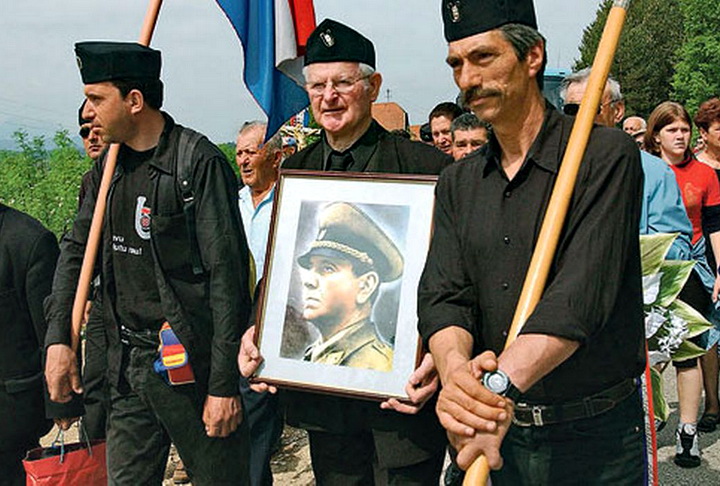
To listen to Igor Vukic, a guest on the popular afternoon chat show ‘Dobar Dan Hrvatska’ (‘Good Day Croatia’) on Croatian Radio-Television, HRT last week, was to enter a parallel universe in which Jasenovac was not a concentration camp but rather a ‘labour and collection camp’ for opponents of the regime, in which inmates like Mirjana were offered opportunities to learn new professions and skills, given access to drama clubs and sporting facilities and treated with compassion by Ustasa guards.
The furore caused by the appearance of Vukic, a former journalist and the secretary of the Society for Research of the Threefold Jasenovac Camp, on a popular afternoon show, is, in some ways, hard to understand. After all, Vukic and other revisionists have been making the rounds of television shows for years, promoting their theories.
Yes, it’s true there was something slightly shocking about how normalised the set up was: the hosts even thoughtfully plugged the society’s book about Jasenovac to viewers at the end of the segment.
But leave aside the prime-time kitsch, and the episode only seems outrageous if you ignore the past 25 years of public discourse in Croatia about the Holocaust and the Ustasa regime.
It was, after all, in the 1990s, not last week, that the idea of mixing the bones of dead Partisans and Ustasas together and refashioning Jasenovac death camp into a site of ‘reconciliation’ was seriously considered.
Which isn’t to say that people shouldn’t be alarmed by what’s happening now: they should.
I would argue there are two reasons why last week’s programme has cuased such a stir. First, unlike the revisionists of the Tudjman era who tended to minimise the crimes of the Ustasa regime or only rehabilitate only certain aspects of it, the new cohort of revisionists are, by their own admission, aiming to rehabilitate the regime in its entirety.
Second, revisionism in the 1990s had its strongholds in the academy and mainstream politics which had a constraining effect on all but the most committed acolytes.
Now, in an age of mass media it has migrated to media platforms. Revisionism hence seems more prevalent and dangerous now because it has essentially become a branch of the entertainment industry, amplified by the ubiquity of social media.
Lest we forget, only a couple of years ago, director Jakov Sedlar’s highly revisionist and fraudulent film about Jasenovac received its premiere in Zagreb, attended by then Culture Minister Zlatko Hasanbegovic.
But no one should be so naïve as to think the current wave of revisionism began last week or even two years ago. The problem goes much deeper than that.
Arguably, Croatia’s leaders have never really known how to deal with the legacy of the Ustasa regime and Jasenovac, the most enduring symbol of its terror.
The narrative offered by the victorious Partisans provided a useable model, initially at least, emphasising the mass participation of Croats in the Partisan movement and the marginality of the Ustasa movement while placing most of the blame on the German occupiers. This was not exactly false but it was a simplified and idealised version of the truth.
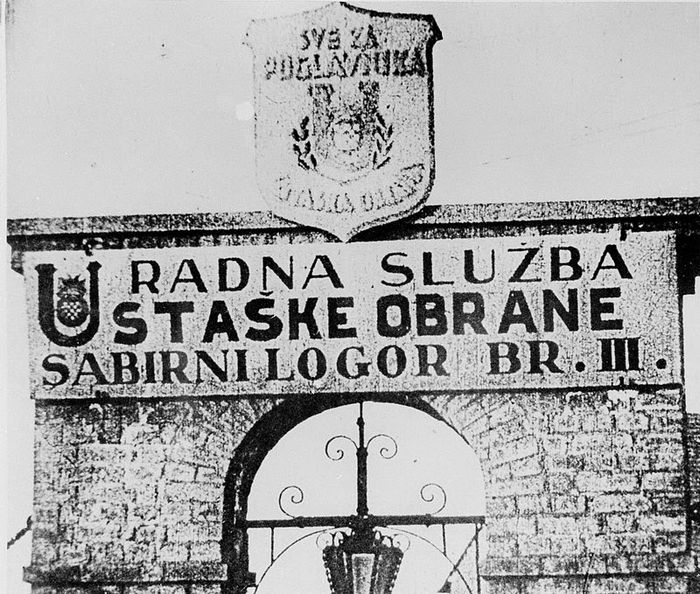 The entrance gate to the Jasenovac death camp
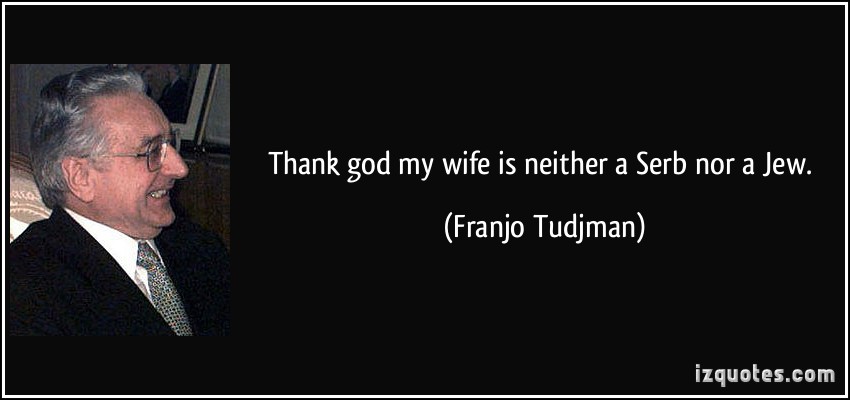
The government of Franjo Tudjman, by contrast, offered a different kind of resolution, combining Ustasa nostalgia and Holocaust minimisation with a much more ambitious project to reconcile Croatian fascists and anti-fascists on the basis of their supposed shared fight for an independent Croatian state.
It also linked Croatia’s struggle for independence in the 1990s to the Croatian ‘independence struggle’ of the 1940s under the Ustasa movement.
In the post-Tudjman years, especially during Croatia’s application to join the European Union, Holocaust memory was Europeanised. As Ljiljana Radonic has written, memory culture transformed Jasenovac into a universal story in which the specifically Croatian identity of the perpetrators was pushed to the margins and the role of the Nazi occupation stressed.
At the same time, the narrative emphasised the specifically Croatian role in the ‘good’ parts of the story, in particular the political oppression of the Croats in inter-war Yugoslavia and the mass participation of Croats in the resistance.
The continued ambivalence regarding the Holocaust in Croatia was apparent at the opening of the Jasenovac Memorial Museum permanent exhibition in 2006 which, as a matter of policy, de-emphasised the national identity of both the victims and the Ustasas as well as their crimes.
Natasa Jovicic, the director of the museum, wrote that the exhibition aimed to restore the individuality of the victims, arguing that the collective identity of the victims and perpetrators had been manipulated in the cause of Serbian nationalism in the early 1990s to generate new hatred.
But this argument was misleading. The people who died in Jasenovac, while they were individuals, were incarcerated in Jasenovac precisely because of their perceived collective identity.
Moreover, in linking the World War II and the wars of the 1990s, the museum exhibition actually legitimated a narrative which has become a leit motif of revisionist forces in Croatia in recent years: namely, that commemorating the crimes of the Ustasa movement constitutes an attempt to blacken the name of Croatia, declare the Croats a genocidal people and criminalise the Homeland War.
On the surface, a narrative which implicated not just ordinary Croats but Croatian identity itself in the crimes of the Ustasa movement through linking defence of the Ustasa regime to patriotism should have permanently discredited revisionists.
After all, when it came to power in 1941, the Ustasa movement enjoyed no popular mandate and was very quickly rejected by a large number of Croats. Still today, the majority of Croats reject the legacy of the Ustasa movement.
Moreover, the constitution of the Republic of Croatia states unambiguously that it is founded on the principles of anti-fascism.
That revisionists have seen their influence actually grow in Croatia is a reflection of the weakness of civil society, a testament to the failure of institutions such as the Catholic Church in Croatia to confront their role in the horror of the 1940s and evidence of the increasingly receptive political climate in which groups such as these are operating.
As the recent controversy about the location of the commemorative plaque for fallen Homeland defenders (1990s Croatian war veterans) in Jasenovac illustrates, invoking the sacrosanct Homeland War has become an increasingly profitable strategy for revisionists and Ustasa nostalgists.
It is no coincidence that Vukic has been a frequent guest on right-wing veteran television shows nor that some of the loudest revisionist voices belong to right-wing war veterans.
At the same time, the growing reach of revisionists would not be possible without the funding and support they have received from the Ministry for Veterans.
In 2017, for example, Vukic’s society was awarded 6,700 euros by the ministry to conduct research on archives related to the Jasenovac camp. Meanwhile, a veterans’ group was awarded 2,700 euros for the publication of a collection of revisionist essays about the Ustasa children’s camp at Jastrebarsko, as part of a scheme which awards funds for applications which “promote the values of the Homeland War.”
What can be done? On the one hand, revisionism and Ustasa nostalgia in Croatia is a problem only Croats themselves can resolve. As the protests of 2016 demonstrated, when large numbers of people come onto the streets across Croatia to say enough is enough, politicians notice.
But there are also more modest actions that can be taken. Paradoxical as it might seem, denying crimes against entire groups of people is much easier than negating crimes against individuals.
As much as anything, perhaps, the Holocaust is made up of small stories and the personal lives of the victims, perpetrators and bystanders. In that sense, the failure of Yugoslav historiography to individualise the victims or perpetrators has been a gift to Holocaust minimizers since it has enabled them to dismiss the official history as an anti-Croatian conspiracy and reframe the victims as opponents of Croatian independence.
One of the reasons, I would argue, why Holocaust denial has tended to be marginal in Austria is because there are reminders of the victims of the Holocaust in every neighbourhood where Jews once lived.
Walk down any street in the old Jewish quarter of Praterstern in Vienna, for example, and there are countless street plaques memorialising the dead, many of them right under your feet.
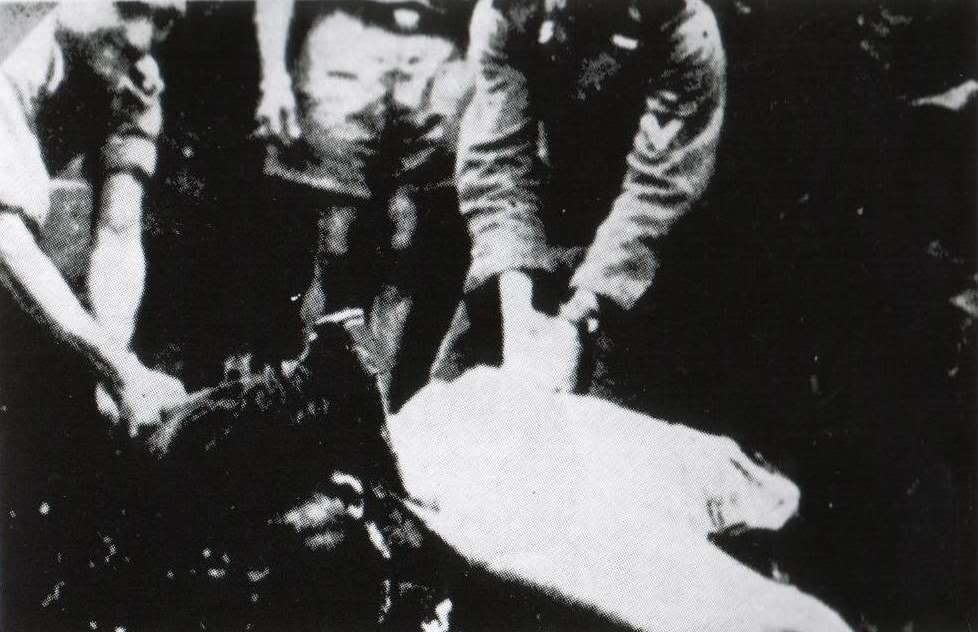 The Jasenovac death camp
By contrast, the buildings in the Derecinova district of downtown Zagreb or Tuskanac are unmarked.
If such an initiative is unthinkable in Croatia at the moment, journalists, researchers and activists can play their part in restoring to the victims of the Holocaust their individuality while emphasising the collective reasons for their fate.
By the time Mirjana Babunovic-Dimitrijevic was arrested by the Ustasa police in 1944, her familiy was scattered: her husband was in Macedonia, her father had long since been detained, one brother was in Dachau, another was a refugee in Serbia. Her identity was the one thing she had which the regime could not take from her.
Her story and the thousands of similar small, personal stories are not only the history of Jasenovac and the Holocaust, but universal stories of resistance and courage.
They are perhaps the most powerful weapon we have in the preservation of a culture of memory and truth against the revisionist culture of lies.

Originally published on 2018-06-06
About the author: Rory Yeomans is a historian and member of the School of Historical Studies, Institute for Advanced Study at Princeton University, author of the book Visions of Annihilation: The Ustasha Regime and the Cultural Politics of Fascism, 1941-1945.
Source: Balkan Transitional Justice
Origins of images: Facebook, Twitter, Wikimedia, Wikipedia, Flickr, Google, Imageinjection & Pinterest.
Read our Disclaimer/Legal Statement!
Donate to Support Us
We would like to ask you to consider a small donation to help our team keep working. We accept no advertising and rely only on you, our readers, to keep us digging the truth on history, global politics and international relations.
[wpedon id=”4696″ align=”left”]