
Crimes against Humanity: Why is Henry Kissinger Walking around Free?
Millions of people around the world, most notably in an invigorated Latin America, are working to end the “might makes right” ethos the US has lived by since its inception [...]
Two months ago, hundreds of thousands of Chileans somberly marked the 40thanniversary of their nation’s September 11th terrorist event. It was on that date in 1973 that the Chilean military, armed with a generous supply of funds and weapons from the United States, and assisted by the CIA and other operatives, overthrew the democratically-elected government of the moderate socialist Salvador Allende. Sixteen years of repression, torture and death followed under the fascist Augusto Pinochet, while the flow of hefty profits to US multinationals – IT&T, Anaconda Copper and the like – resumed. Profits, along with concern that people in other nations might get ideas about independence, were the very reason for the coup and even the partial moves toward nationalization instituted by Allende could not be tolerated by the US business class.
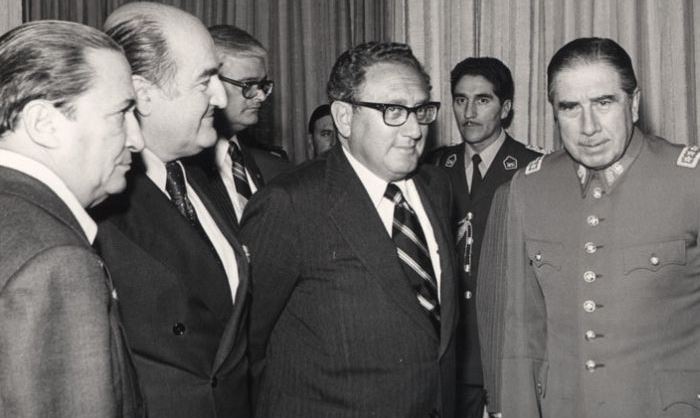
Henry Kissinger was national security advisor and one of the principle architects – perhaps the principle architect – of the coup in Chile. US-instigated coups were nothing new in 1973, certainly not in Latin America, and Kissinger and his boss Richard Nixon were carrying on a violent tradition that spanned the breadth of the 20th century and continues in the 21st – see, for example, Venezuela in 2002 (failed) and Honduras in 2009 (successful). Where possible, such as in Guatemala in 1954 and Brazil in 1964, coups were the preferred method for dealing with popular insurgencies. In other instances, direct invasion by US forces such as happened on numerous occasions in Nicaragua, the Dominican Republic and many other places, was the fallback option.
The coup in Santiago occurred as US aggression in Indochina was finally winding down after more than a decade. From 1969 through 1973, it was Kissinger again, along with Nixon, who oversaw the slaughter in Vietnam, Cambodia and Laos. It is impossible to know with precision how many were killed during those four years; all the victims were considered enemies, including the vast majority who were non-combatants, and the US has never been much interested in calculating the deaths of enemies. Estimates of Indochinese killed by the US for the war as a whole start at four million and are likely more, perhaps far more. It can thus be reasonably extrapolated that probably more than a million, and certainly hundreds of thousands, were killed while Kissinger and Nixon were in power.
In addition, countless thousands of Indochinese have died in the years since from the affects of the massive doses of Agent Orange and other Chemical Weapons of Mass Destruction unleashed by the US. Many of us here know (or, sadly, knew) soldiers who suffered from exposure to such chemicals; multiply their numbers by 1,000 or 10,000 or 50,000 – again, it’s impossible to know with accuracy – and we can begin to understand the impact on those who live in and on the land that was so thoroughly poisoned as a matter of US policy.
Studies by a variety of organizations including the United Nations also indicate that at least 25,000 people have died in Indochina since war’s end from unexploded US bombs that pocket the countryside, with an equivalent number maimed. As with Agent Orange, deaths and ruined lives from such explosions continue to this day. So 40 years on, the war quite literally goes on for the people of Indochina, and it is likely it will go on for decades more.
Near the end of his time in office, Kissinger and his new boss Gerald Ford pre-approved the Indonesian dictator Suharto’s invasion of East Timor in 1975, an illegal act of aggression again carried out with weapons made in and furnished by the US. Suharto had a long history as a bagman for US business interests; he ascended to power in a 1965 coup, also with decisive support and weapons from Washington, and undertook a year-long reign of terror in which security forces and the army killed more than a million people (Amnesty International, which rarely has much to say about the crimes of US imperialism, put the number at 1.5 million).
In addition to providing the essential on-the-ground support, Kissinger and Ford blocked efforts by the global community to stop the bloodshed when the terrible scale of Indonesian violence became known, something UN ambassador Daniel Patrick Moynihan openly bragged about. Again, the guiding principle of empire, one that Kissinger and his kind accept as naturally as breathing, is that independence cannot be allowed. That’s true even in a country as small as East Timor where investment opportunities are slight, for independence is contagious and can spread to places where far more is at stake, like resource-rich Indonesia. By the time the Indonesian occupation finally ended in 1999, 200,000 Timorese – 30 percent of the population – had been wiped out. Such is Kissinger’s legacy and it is a legacy well understood by residents of the global South no matter the denial, ignorance or obfuscation of the intelligentsia here.
If the United States is ever to become a democratic society, and if we are ever to enter the international community as a responsible party willing to wage peace instead of war, to foster cooperation and mutual aid rather than domination, we will have to account for the crimes of those who claim to act in our names like Kissinger. Our outrage at the crimes of murderous thugs who are official enemies like Pol Pot is not enough. A cabal of American miss-leaders from Kennedy on caused for far more Indochinese deaths than the Khmer Rouge, after all, and those responsible should be judged and treated accordingly.
The urgency of the task is underscored as US aggression proliferates at an alarming rate. Millions of people around the world, most notably in an invigorated Latin America, are working to end the “might makes right” ethos the US has lived by since its inception. The 99 percent of us here who have no vested interest in empire would do well to join them.
There are recent encouraging signs along those lines, with the successful prevention of a US attack on Syria particularly noteworthy. In addition, individuals from various levels of empire have had their lives disrupted to varying degrees. David Petraeus, for example, has been hounded by demonstrators since being hired by CUNY earlier this year to teach an honors course; in 2010, Dick Cheney had to cancel a planned trip to Canada because the clamor for his arrest had grown quite loud; long after his reign ended, Pinochet was arrested by order of a Spanish magistrate for human right violations and held in England for 18 months before being released because of health problems; and earlier this year, Efrain Rios Montt, one of Washington’s past henchmen in Guatemala, was convicted of genocide, though accomplices of his still in power have since intervened on his behalf to obstruct justice.
More pressure is needed, and allies of the US engaged in war crimes like Paul Kagame should be dealt with as Pinochet was. More important perhaps for those of in the US is that we hound Rumsfeld, both Clintons, Rice, Albright and Powell, to name a few, for their crimes against humanity every time they show themselves in public just as Petraeus has been. That holds especially for our two most recent War-Criminals-in-Chief, Barack Obama and George W. Bush.
Note: This article was originally published in January 2015.
About the author: Andy Piascik is a long-time activist and award-winning author who writes for Z, Counterpunch and many other publications and websites. He can be reached at andypiascik@yahoo.com
We would like to ask you to consider a small donation to help our team keep working. We accept no advertising and rely only on you, our readers, to keep us digging the truth on history, global politics, and international relations.
More than 6,400 civilians have been killed and nearly 16,000 injured as result of criminal actions of Kiev regime during the conflict in Donbass, Chairman of the Russian Investigative Committee Alexander Bastrykin said on Thursday. Also, more than 10,000 residential infrastructure facilities have been fully or partially destroyed and burnt. Since last April, more than 1 million Russian-speaking residents of Lugansk and Donetsk regions had to flee their homes, and more than 110,000 people having a refugee status have applied for the Russian citizenship. The war has been continuing.Ukrainian capital being wrapped in smoke due to a spate of regional ...
U.S. media have given more attention to hearsay allegations of Julian Assange’s sexual encounters with two talkative Swedish women than to an official report accusing Kosovo prime minister Hashim Thaci of running a criminal enterprise which, among almost every other crime in the book, has murdered prisoners in order to sell their vital organs on the world market.The report by Swiss liberal Dick Marty was mandated two years ago by the Parliamentary Assembly of the Council of Europe (PACE). Not to be confused with the European Union, the Council of Europe was founded in 1949 to promote human rights, the ...
The focal questions about war In dealing from both theoretical and practical points of view about war, at least six fundamental questions arise: 1) What is war?; 2) What types of war exist?; 3) Why do wars occur?; 4) What is the connection between war and justice?; 5) The question of war crimes?; and 6) Is it possible to replace war with the so-called “perpetual peace”?Probably, up to today, the most used and reliable understanding of war is its short but powerful definition by Carl von Clausewitz:“War is merely the continuation of politics by other means” [On War, 1832]. It can be ...
The best reporting on the depth of America’s dictatorship is probably that being done by Atlanta Georgia’s NBC-affiliated, Gannett-owned, TV Channel “11 Alive”, WXIA television, “The Investigators” series of local investigative news reports, which show, up close and at a cellularly detailed level, the way things actually work in today’s America. Although it’s only local, it displays what meets the legal standards of the US federal government in actually any state in the union; so, it exposes the character of the US government, such that what’s shown to be true here, meets America’s standard for ‘democracy’, or else the federal ...
Author’s noteThe following article focussing on the jihadist terrorist insurgency in Macedonia was first published by antiwar.com in July 2001, barely two months before the September 11, 2001 attacks on the WTC and the Pentagon.Known and documented, since the Soviet-Afghan war, recruiting Mujahedin (“holy warriors”) to fight covert wars on Washington’s behest had become an integral part of US foreign policy. A report of the US Congress had revealed how the US administration – under advice from the National Security Council headed by Anthony Lake – had “helped turn Bosnia into a militant Islamic base” leading to the recruitment through ...
Six Years Later, Kosovo Still WrongIn the early hours of March 24, 1999, NATO began the bombing of what was then the Federal Republic of Yugoslavia. For some reason, many in the targeted nation thought the name of the operation was “Merciful Angel.” In fact, the attack was code-named “Allied Force” – a cold, uninspired and perfectly descriptive moniker. For, however much NATO spokesmen and the cheerleading press spun, lied, and fabricated to show otherwise (unfortunately, with altogether too much success), there was nothing noble in NATO’s aims. It attacked Yugoslavia for the same reason then-Emperor Bill Clinton enjoyed a ...
By the time you read this piece, it will already be out of date. The reason’s simple enough. No matter what mayhem I describe, with so much all-American weaponry in this world of ours, there’s no way to keep up. Often, despite the headlines that go with mass killings here, there’s almost no way even to know.On this planet of ours, America is the emperor of weaponry, even if in ways we normally tend not to put together. There’s really no question about it. The all-American powers-that-be and the arms makers that go with them dream up, produce, and sell ...
With the March 24 ICTY decision condemning Former Bosnian Serb leader Radovan Karadzic for war crimes, exactly 17 years after NATO began its bombing spree on Serbia, international criminal justice revealed itself once again as an instrument of US and NATO foreign policy.[They chose that the 24th of March to render judgment regarding Karadzic iquite deliberately with a view to erasing the history of NATO crimes.]If any doubts persist, it is worth remembering how the Former US Ambassador-at-Large for War Crimes Issues, David Scheffer, perceived that tribunal. Writing about it in his memoirs, Scheffer wrote unabashedly:the tribunal was an important judicial tool, and I had enough ...
A map of the wanted territories of the Balkan states in 1915There are many talks about nationalism among the peoples from the former Yugoslavia during the last three decades what is quite understandable taking into consideration the post-Cold War conflicts and atrocities, as a continuation of WWII crimes based on certain political ideologies,[i] committed on the territory of ex-Yugoslavia.Historia est magistra vitaeI want to argue that there is a direct link between contemporary nationalism(s) among the Yugoslavs and their national ideologies, which are developed in the previous decades and even centuries. What happened with the Yugoslavs from 1991 to 1999 ...
Over the past several years, analysts and commentators have noticed a rising tide of domestic support for the Croatian homegrown Nazi movement of the Second World War, the Ustashe, which actively exterminated Serbs, Jews, and Roma in the territory it controlled from 1941-45. Far from condemning this alarming development, the Croatian government, the European Union, and non-state actors within it have tacitly and actively supported the rising tide of sympathy towards the Ustashe.This disconnect between the ostensible “European values” of human rights and tolerance that the European Union claims to represent, and its tacit support of trends towards extremist politics ...
With Monday’s procedural vote in the U.S. Senate to allow Montenegro into NATO, the Washington elite proved once more that heightening tensions with Russia might not just be inevitable, but actually desirable. With the exception of Rand Paul (R-KY) and Mike Lee (R-UT), the entire 100-strong body of the Senate rallied behind the motion that would see the tiny Adriatic state admitted into the Atlantic alliance over the objections of many Montenegrins . The vote set off a 30-hour countdown, during which Senators will debate before putting the issue to a final vote.If you needed more proof that US foreign ...
June 10 is a sad date in the history of the UN, the institution originally meant to play the key role in ensuring peace, security, and the primacy of law in the world. The decade since the passing of the June 10, 1999 UN Security Council Resolution 1244 addressing the Kosovo problem – the document totally ignored throughout the period – has shown that the UN is no longer playing the role prescribed to it by the post-World War II system of the international law. The Resolution the tenth anniversary of which nobody seems willing to celebrate in the UN ...
US foreign policy has for decades been predicated on achieving and maintaining global peace, security and stability. In reality, it has for over a century constituted an overreaching desire to achieve and maintain global hegemony.And where US efforts focus on achieving hegemony, division and destruction follow. From the Middle East to Eastern Europe, and from Southeast Asia to the Korean Peninsula, US intervention politically or militarily all but guarantee escalating tensions, uncertain futures, socioeconomic instability and even armed conflict.The Middle East and North Africa US efforts in the Middle East since the conclusion of the first World War have focused ...
Ukraine is a virtual US colony – the way it’s been since the Obama regime’s February 2014 coup, replacing democratic governance with fascist tyranny in Europe’s heartland.Ukraine shares a near-1,500 mile land and sea border with the Russian Federation, the longest Western frontier with the country.The regime running things is a hotbed of militarized extremism, waging war on its own people, committing appalling human rights abuses – with full support and encouragement from Washington and key NATO countries.Stop NATO’s Rick Rozoff earlier explained that Ukraine is “the decisive linchpin in plans by the US and its NATO allies to effect ...
A blast caused by a suicide car bombing hit the center of Ankara on Sunday evening (March 13th, 2016) resulting in over a hundred casualties. The Turkish authorities were very quick to announce the identity of the suicide person: A Kurdish woman in close relation with the Kurdistan Workers Party. Nevertheless, this terror act in Ankara once again opened the “Kurdish Question” which is in direct connection with the question of Kurdistan’s independence and terrorism as the political instrument in the realization of the national projects and ultimate goals.PrologueThere are many the so-called “stateless nations” or better to say “stateless ...
While it is certainly true that the Jewish people have relatively deep roots in the land that is today known as Palestine and Israel, this area has been a crossroads since the origins of the human species. In fact the oldest known Homo sapiens fossil outside of Africa was recently found in modern-day Israel, dated at approximately 180,000 years old. Neanderthal bones have also been found in the Levant.In historical times the Palestine region or parts of it have been controlled by numerous different peoples and regional powers, including the Canaanites, Amorites, Ancient Egyptians, Israelites, Moabites, Ammonites, Philistines, Assyrians, Babylonians, ...
Seventy-five years ago Adolf Hitler launched the biggest and most destructive military campaign in history when three million German and allied troops invaded the Soviet Union along a 1,000-mile front.Operation Barbarossa – the codename for the German invasion of Russia - was no ordinary military campaign: it was an ideological and racist war, a war of destruction and extermination that aimed to kill Jews, enslave the Slavic peoples and destroy communism. The result was a war in which 25 million Soviet citizens died, including a million Jews, executed by the SS in 1941-1942 – an action which became the template ...
There are many definitions and/or understandings of war. However, from the very academic point of view, war can be understood as an armed conflict between at least two sides usually but not necessarily states fought usually for some (geo)political goals. The focal conceptual idea of war is the use of force between large-scale political subjects like states, empires, or coalitions. Historically, wars have been fought mainly for the control of certain land for different reasons ranging from a purely political one to a purely economic one or a combination of several of them.Many types of war and warfare can be ...
In the period before the 1999 NATO attack on Yugoslavia, the Kosovo Liberation Army (KLA) waged a campaign to secede and establish an independent Kosovo dominated by Albanians and purged of every other ethnic group. In October 1998, KLA spokesman Bardhyl Mahmuti spelled the KLA’s vision:“We will never change our position. The independence of Kosovo is the only solution…We cannot live together [with Serbs]. That is excluded.”Once NATO’s war came to an end, the KLA set about driving out of Kosovo every non-Albanian and every pro-Yugoslav Albanian it could lay its hands on. The KLA left in its wake thousands ...
A year ago, at a closed-doors meeting between the USA and EU officials and the leaders of the four major parties of FYROM in Strasbourg, a route map for the resolution of the protracted political crisis was agreed on (or rather imposed). The roots of this political crisis are to be found outside FYROM: it is actually more a confrontation by proxy between “the West”, which supports the opposition, and Russia, which is trying to maintain its influence in the region. In conjunction with the public discontent at government policies and the escalating corruption, the negotiations have contributed to sharpening ...