
This Remembrance Day will doubtless see strenuous efforts by some to justify the fruitless bloodbath that was the First World War. Revisionist commentators have long attempted to rehabilitate the conflict as necessary and just, but the arguments do not stand up. It does no service to the memory of the dead to allow any illusions in the justice or necessity of war, particularly so when the precedents will be used to argue for the next ‘necessary’ conflict. From the causes of the war, to its prosecution and its results, here are the counter-arguments to ten common pro-war ploys.
1. The war was fought in defence of democracy
This is contradicted by the basic facts. Germany had universal manhood suffrage while in Britain, including Ireland, some 40% of men still did not qualify for the vote. In Germany also, there were attempts to justify the war on the grounds that it was being fought to defend civilised values against a repressive, militaristic state, in the form of Russian autocracy.
2. Britain went to war due to a treaty obligation to defend the neutrality of Belgium
There was no clear and accepted obligation on Britain to do this, and, in fact, before the Belgian issue appeared, the war party in the cabinet was already pushing for British intervention on the entirely different ground that there were naval obligations to France. These obligations had been developed in secret arrangements between the military of both countries, and were never subject to any kind of democratic accountability. The Germans even offered guarantees over Belgian integrity, which the British government refused to consider at all.
3. German aggression was the driving force for war
However aggressive the German leadership may have been in 1914, the British establishment was at least as determined to take the opportunity to go to war with its imperial rival. At one point the Foreign Office even seized on imaginary German incursions into France to justify a British declaration of war on Germany. The declaration letter had to be retrieved from the German ambassador and rewritten when it was discovered that the stories were false. The enthusiasm of the British ruling class for war undermines any justification for it based on German aggression.
4. Germany had started a naval arms race with Britain
Imperialist competition between the two states over markets and resources preceded the arms race in the fifteen years before the war. Britain’s naval power was the vital element in its ability to restrict German access to markets and resources across the world. Unless Britain was willing to allow Germany to expand economically, the logic of capitalist competition meant that Germany was bound to challenge British naval supremacy. The latent violence of the leading imperial nation is always the context for aggressive challenges to the status quo on the part of rising powers.
5. German imperialism was uniquely vicious and had to be challenged
The atrocities committed against the Herrero people in Namibia were indeed terrible crimes, but were hardly unique compared to the horrors committed by all those involved in the rubber industry in the Belgian Congo, to take but one example. Also, European opinion had only a few years before 1914 been horrified by the brutality of another colonial power when it was engaged in ruthlessly expanding its dominance over independent states in Africa. This was Britain in its wars of aggression against the Boer states in South Africa, during which concentration camps were first used in order to control a civilian population.
6. Public opinion was united in favour of the war, as shown by images of cheering crowds in 1914
It is now usually admitted that the degree of enthusiasm for the war was strictly limited, and the evidence is that the crowds who gathered at the outbreak of war were by no means united in martial enthusiasm. In fact sizeable and widespread anti-war demonstrations occurred in both Britain and Germany. Had the leaderships of Labour and Socialist parties across Europe not caved into demands to support their national ruling classes in going to war, it is quite possible that the conflict could have been stopped in its tracks.
7. The morale of British troops fighting on the Western Front remained intact to the end of the war
While Britain may not have suffered quite the same scale of mutinies as in the German and French armies, at times there were whole stretches of the front where troops became so unreliable that generals did not dare order them into combat. The evidence for widespread cynicism about war strategies, contempt for the military leadership, and grave doubts about the purpose of the war, cannot be wished away by the revisionists. In so far as soldiers carried on willingly fighting the war, the explanation needs to be sought in the habituation to obedience, as well as the threat of court-martial executions. There is no need to invoke either fervid nationalism or any kind of deep psychological blood-lust as explanations.
8. The military leadership, notably General Haig, was not a bunch of incompetent ‘donkeys’
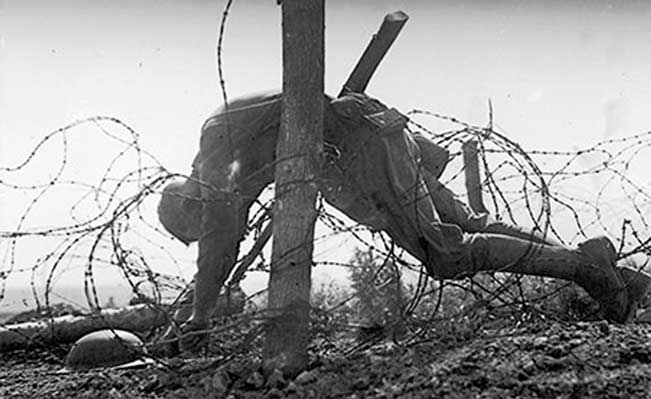
Attempts to rehabilitate the likes of General Haig founder on some of the basic facts about the tactics he relentlessly employed. Repeated infantry attacks on opposing trenches consistently failed to gain any clear advantage, while causing colossal casualties. On the first day of the battle of the Somme, 1st July 1916, 57,000 troops out of 120,000 were killed or wounded. Despite continuing carnage on an incredible scale, Haig carried on ordering further attacks. When any hope of a breakthrough against the German lines was clearly lost, the purpose of the battle was shifted to attrition pure and simple. The plan now was to kill more German troops than the British lost. Since there was no way of reliably measuring the casualties on the other side, Haig relied on estimating it through the losses of his own side. On this basis he began to be angered when the army suffered too few losses, as when he complained that one division in September had lost under a thousand men. There can be no defence for this kind of disregard of human life.
9. The end of the war saw the triumph of liberal capitalism, against collapsing autocratic Empires
In fact all states involved in the war were deeply destabilised. Even the United States, whose involvement was the most limited, experienced the ‘Red Summer’ of 1919, with unprecedented labour revolts, such as the Seattle general strike, alongside savage repression of socialists and black Americans. Britain saw the beginning of the Irish war of independence, and increasing unrest in India, which marks, in effect, the point at which the Empire began to unravel. Domestically, there was also a wave of radical working-class unrest, particularly in the ‘Red Clydeside’, which culminated in troops being sent into Glasgow to impose martial law.
10. The war achieved anything worthwhile whatsoever
The war opened up a period of endemic economic dislocation, and outright crisis. In Britain there was a decade of industrial decline and high unemployment even before the Great Depression. In effect, it was only the Second World War which brought the major capitalist powers out of the slump. The First World War saw the point at which capitalism became addicted to war and to a permanent arms economy. The war demonstrated the capacity of capitalism to create industrialised waste, carnage and destruction on a colossal scale. The remembrance of the war is appropriately a time for mourning the horror, the loss and the waste of it all, but it should also provoke a determination to resist our rulers’ insistence on promoting war to further their interests. War can achieve nothing other than to create the conditions for further wars.
Popular opinion has, ever since its ending, remembered the First World War as a time of horrendous and futile misery and slaughter, as epitomising political and military leaders’ incompetence and callous disregard for human life. That popular judgement, which has helped turn common opinion against war in general, was correct, and we must not let the war mongers dismiss this instance of the wisdom of ordinary people.
Originally published on 2014-11-09
About the author: Dominic Alexander is a member of Counterfire, for which he is the book review editor. He has been a Stop the War and anti-austerity activist in north London for some time. He is a published historian whose work includes the book Saints and Animals in the Middle Ages, a social history of medieval wonder tales.
We would like to ask you to consider a small donation to help our team keep working. We accept no advertising and rely only on you, our readers, to keep us digging the truth on history, global politics, and international relations.
On February 2014, a United States-sponsored coup was initiated in the Ukraine in which President Viktor Yanukovych was illegally ousted from power. (1) Over three years later, the putsch has done nothing but plunge the Ukraine, a tortured country plundered throughout modern history (by the West), into another abyss. In a 2015 interview with CNN, then US president Barack Obama openly confessed that “we had brokered a deal to transition power in Ukraine”.Around 10,000 people have been killed in the time since, with the conflict generating 2.5 million refugees who relocated to Russia. The putsch led to Crimea’s annexation a month after ...
Russia and its President, Vladimir Putin, a little more than a year ago, in July 2014 were the focus of attention in Europe and North America, accused, without a shred of forensic evidence, of shooting down an unarmed civilian Malaysian airliner over eastern Ukraine. The Russians were deemed out to restore the Soviet Union with their agreement to the popular referendum of Crimean citizens to annex into the Russian Federation and not Ukraine. Western sanctions were being thrown at Russia by both Washington and the EU. People spoke of a new Cold War. Today the picture is changing, and profoundly. ...
Strange things happen in civil wars: During the Russian Civil War in 1919, 13,000 U.S. troops were dispatched by President Woodrow Wilson to occupy the cities of Archangelsk in the Arctic and Vladivostok on the Pacific.Half a century earlier, thousands of Imperial Russian Navy sailors and their officers flooded the cities of San Francisco and New York. But the circumstances were very different. They were there to defend the United States from foreign invasion – not to threaten it and they brilliantly succeeded in their tasks.The incredible story is well told in “Friends in Peace and War: The Russian Navy’s ...
Serbs: Basic factsEthnic location: Central and western part of the Balkan Peninsula (South-East Europe)Population: 10.2 million (1.8 million Serbs live outside their ethnic location)Language: SerbianReligion: Eastern Orthodox Christians1 Introduction Serbs belong to the Southslavonic group of Indo-European peoples. As their tradition, culture, language, beliefs, and customs show, the ethnogenesis of Serbs goes far back into the past. Serbian ancestors, Protoslavs and Old Serbs, were described in the 5th century BC by Herodotus, under the names of Neuri and Budini, living north of the Danube in the region between Dniepar and north-eastern Carpathian Mountains.The first mention of the name “Serbs” appears ...
“In the event of a nuclear war, there will be no chances, there will be no survivors – all will be obliterated… nuclear devastation is not science fiction – it is a matter of fact. The world now stands on the brink of the final abyss. Let us all resolve to take all possible practical steps to ensure that we do not, through our own folly, go over the edge.” Former First Sea Lord, Lord Louis Mountbatten (1900-1979) Strasbourg, 11 May 1979.”As US threats ratchet up towards North Korea, the latest hinging on the accusation that the country attempted a ...
A peaceful dissolution of the USSR according to the agreement between Mikhail Gorbachev and Ronald Reagan in 1988 in Reykjavik brought a new dimension of global geopolitics in which up to 2008 Russia, as a legal successor state of the USSR, was playing an inferior role in global politics when an American Neocon concept of Pax Americana became the fundamental framework in international relations. Therefore, for instance, Boris Yeltsin’s Russia capitulated in 1995 to the American design regarding an outcome of the USA/EU policy of the destruction of ex-Yugoslavia in November 1995 (the Dayton Agreement) followed by even worse political ...
Arrest and detention of three days for Joanikije, Bishop of Budimlye and Niksic, and eight priests of the Orthodox Cathedral of St. Basil of Ostrog in Nikšić has sparked tensions in Montenegro again. Namely, after the prayer procession that had been held in Nikšić on May 12th, on the feast-day of St. Basil of Ostrog, a 72-hour detention was ordered for Bishop Jonikije, Fr. Slobodan Jokic, Fr. Danilo Zirojevic, Fr. Zeljko Rojevic, Fr. Ostoja Knezevic, Fr. Mirko Vukotic, Fr. Vasilije Brboric, Fr. Dragan Krusic and Fr. Nikola Marojevic.Protests in support of those arrested have taken place in several cities across ...
In the aftermath of the U.S. invasion of Iraq in 2003 – an invasion which many Iraqis believe left their country in the worst condition it has been since the Mongol invasion of 1258 — there was much discussion in the media about the Bush Administration’s goal for “nation-building” in that country. Of course, if there ever were such a goal, it was quickly abandoned, and one hardly ever hears the term “nation-building” discussed as a U.S. foreign policy objective anymore.The stark truth is that the U.S. really has no intentions of helping to build strong states in the Middle ...
From the very historical perspective, the Middle East has been marked by diversity being a crossroads of civilizations. Nevertheless, at the time of Antique, the region was referred to as Mesopotamia (in Greek, the land between, i.e. between two rivers: Tigris and Euphrates), the Fertile Crescent (from Egypt via Palestine to Mesopotamia) where from originally both agriculture and rural/urban settlements started to be developed. At that time, what is today known as Libya, the land was rich in olives, wine, and livestock, and neighboring Egypt was a marshland with wildlife and cane forests. The farming and techniques of irrigation systems ...
AcknowledgementsTo Benjamin H. Freedman, who committed himself to finding and telling the facts about Zionism and Communism. and encouraged others to do the same. The son of one of the founders of the American Jewish Committee, which for many years was anti-Zionist, Ben Freedman founded the League for Peace with Justice in Palestine in 1946. He gave me copies of materials on the Balfour Declaration which I might never have found on my own and encouraged my own research. (He died in April 1984.)The Institute for Historical Review is providing means for the better understanding of the events of our ...
Their anxiety about the future of NATO, recently on full display again when the American president was in Europe, could not be bettered as a measure of the incapacity of Europe’s top politicians to guide their continent and represent its populations. Through its provocations of Moscow, NATO systematically helps increase the risk of a military confrontation. By thus sabotaging its declared purpose of preserving collective security for the countries on either side of the Atlantic, it erases its fundamental reason for being and right to exist.Grasping these facts ought be enough to fuel moves aimed at quickly doing away with ...
Thanksgiving recalls for many people a meal between European colonists and indigenous Americans that we have invested with all the symbolism we can muster. But the new arrivals who sat down to share venison with some of America’s original inhabitants relied on a raft of misconceptions that began as early as the 1500s, when Europeans produced fanciful depictions of the “New World.” In the centuries that followed, captivity narratives, novels, short stories, textbooks, newspapers, art, photography, movies and television perpetuated old stereotypes or created new ones — particularly ones that cast indigenous peoples as obstacles to, rather than actors in, ...
“A famous American family” made its fortune from the Nazis, according to John Loftus’ documented historical analysis. The Bush family links to Nazi Germany’s war economy were first brought to light at the Nuremberg trials in the testimony of Nazi Germany’s steel magnate Fritz Thyssen. Thyssen was a partner of George W. Bush’s grandfather Prescott Bush: From 1945 until 1949 in Nuremberg, one of the lengthiest and, it now appears, most futile interrogations of a Nazi war crimes suspect began in the American Zone of Occupied Germany.Multibillionaire steel magnate Fritz Thyssen-the man whose steel combine was the cold heart of the Nazi war machine-talked and ...
The United States Government is now treating Ukraine as if it were a NATO member, and on September 27th donated to Ukraine two warships for use against Russia. This is the latest indication that the US is switching to Ukraine as the locale to start World War III, and from which the nuclear war is to be sparked against Russia, which borders Ukraine.Here is why Syria is no longer the US alliance’s preferred choice as a place to start WW III:On September 4th, US President Donald Trump publicly threatened Syria, Iran and Russia that if they exterminated the jihadists in Syria’s only remaining jihadist-controlled ...
Preface The Palestine Liberation Organization (the PLO) is established in 1964 on the initiative of Egypt. The organization had the focal intention to unite several Arab-Palestine movements and groups which all of them have been enemies to the Zionist Israel and above all to Israeli existence on the land of Palestine.[1] The most important of those movements and groups were: al-Fatah (The Palestine National Liberation Movement),[2] the Marxist Popular Front for the Liberation of Palestine, and the Democratic Front for the Liberation of Palestine.From the formal viewpoint, the external character of the PLO advocated the creation of both a secular and ...
Fascist Franco may have been dead for more than four decades, but Spain is still encumbered with his dictatorial corpse. A new paradigm has been coined right inside the lofty European Union, self-described home/patronizing dispenser of human rights to lesser regions across the planet: “In the name of democracy, refrain from voting, or else.” Call it democracy nano-Franco style.Nano-Franco is Spanish Prime Minister Mariano Rajoy, whose heroic shock troops were redeployed from a serious nationwide terrorist alert to hammer with batons and fire rubber bullets not against jihadis but … voters. At least six schools became the terrain of what was correctly called The ...
On the 29th of November, 2015, Foreign Affairs – the publication of the Council on Foreign Relations (CFR) – published an article titled: Divide and Conquer in Syria and Iraq; Why the West Should Plan for a Partition. It was written by Barak Mendelsohn, an Associate Professor of Political Science at Haverford College and a Senior Fellow at the Foreign Policy Research Institute. In the article, he argues that the “solution” to the current crisis in Syria and Iraq is the creation of an “independent Sunni state” (or Sunnistan), in addition to separating “the warring sides:”“The only way to elicit ...
During the early 1960s, apartheid South African diplomats were increasingly concerned their country’s plummeting reputation would affect relations with America. In one notorious incident, of March 1960, South African police shot dead 69 black protesters in Sharpeville, a township about 40 miles from Johannesburg.Such atrocities sparked protests against the racist regime on the streets of England, America’s great ally, which surely did not go unnoticed in Washington. Aware of the changing climate, South Africa’s dignitaries pleaded with their American counterparts for continued assistance. They need not have worried that the earth’s dominant power would desert them.As long as the United ...
With a critical public increasingly turning to social media to scrutinize the claims of the mainstream as well as the credibility of the assertions made by the various NGOs and government-funded human rights organisations, it’s arguably becoming more difficult for the corporate press to pass their propaganda off as legitimate news.This is particularly the case during periods when the establishment pushes for military conflicts. One salutary lesson from the Iraq debacle, is that the public appear not to be so readily fooled. Or are they?It’s a measure of the extent to which the mass media barely stray from their paymasters ...
It was NATO’s first out-of-area operation, against its own Treaty and without a UN mandate. On March 24, 1999.Independent Kosovo was established – against UN SC resolution 1244. Thanks to the Clinton administration and Madeleine Albright. CNN’s Amanpour endorsed it generously on TV with her State Department husband, James Rubin, a chief operator in the non-negotiations at Rambouillet. And TIME of course knew the truth too.Serbia suffered tremendously from the 78 days of indiscriminate, hard bombing. I know because I was there.Finally, Serbia and its president Milosevic was threatened with total destruction of Belgrade. And gave in.Western hubris after the ...