
FYROM Should be Named Paionia as it was 2,500 Years Ago
Even more significantly for the assimilation of Paionia into the Greek world are the dedications of statues of Paionian kings made at Delphi and Olympia, and especially the bronze head of a Paionian bison, also at Delphi [...]
The name of the modern land-locked country north of Greece, with its capital at Skopje, has returned to the news. It is officially called FYROM, but embedded in that name is “Macedonia” which is a reflection of the longstanding attempt to take over the modern Greek province of Macedonia as reflected in maps used in many places, including schools.
It is clear that this naming implies territorial ambitions which have long been understood (http://macedonia-evidence.org/documentation.html). If that threat to the stability of the southern Balkans is to be stopped permanently, I suggest that the following must happen:
The land in question, with its modern capital at Skopje, was called Paionia in antiquity. Mts. Barnous and Orbelos (which form today the northern limits of Greece) provide a natural barrier that separated, and separates, Macedonia from its northern neighbor. The only real connection is along the Axios/Vardar River and even this valley “does not form a line of communication because it is divided by gorges.”
The geographic situation is made clear by Livy’s account of the creation of the Roman province of Macedonia in 146 B.C. (Livy 45.29.7 and 45.29.12). The land north of Mt. Barnous and Mt. Orbelos was inhabited by Paionians. The natural barrier formed by these mountains must be acknowledged. Barnous (modern Voras or Kaimaktsalan) reaches a height of 2524 meters, while Orbelos (the whole range extending to east and west of the Strymon; the western ridge is the modern Beles or Kerkini with a height of 1474 meters) has a maximum height toward the east of 2211 meters.
Strabo (7. frag 4), writing a few years before the birth of Christ, is even more succinct in saying that Paionia was north of Macedonia and the only connection from one to the other was (and is today) through the narrow gorge of the Axios (or Vardar) River.
The ancient Paionians may or may not have been Greek, but they certainly became ‘Greekish’, and they were never Slavs. They were also not Macedonians. Ancient Paionia was a part of the Macedonian Empire. So were Ionia and Syria and Palestine and Egypt and Mesopotamia and Babylonia and Bactria and many more. They may thus have become “Macedonian” temporarily, but none was ever “Macedonia”. The theft of Philip and Alexander by a land that was never Macedonia, cannot be justified.
The traditions of ancient Paionia could be adopted by the current residents of that geographical area with considerable justification. But the extension of the geographic term “Macedonia” to cover southern Yugoslavia cannot. Even in the late 19th century, this misuse implied unhealthy territorial aspirations.
Unfortunately relatively little is known about the ancient Paionians, partly because “no Paionian Philip ever dominated Greece, and no Paionian Alexander ever conquered the known world” ( Irwin L. Merker, “The Ancient Kingdom of Paionia,” Balkan Studies 6 (1965) 35).
Nonetheless, they appear already in the Trojan War (albeit on the Trojan side; Homer, Iliad 2.848-850, 16.287-291, 17.348-351). Their confrontation with the Persians is recorded by Herodotus (5.1, 12-17). They fought against Philip who subdued them and with Alexander against the Persians, especially in the Battle of Gaugamela in 331 B.C. (Quintus Curtius, History of Alexander 4.9.24-25).
They enjoyed, even under the Macedonians, a certain degree of autonomy as is shown by their negotiations with Athens (IG II2 127), and the many coins minted under a series of Paionian kings, whose names are Greek and inscribed in Greek on the coins. See, for example, the following silver issue of Patraos, probably depicting the slaying of a Persian satrap by the Paionian Ariston, as told by Quintus Curtius (above).
Even more significantly for the assimilation of Paionia into the Greek world are the dedications of statues of Paionian kings made at Delphi and Olympia, and especially the bronze head of a Paionian bison, also at Delphi. See BCH 1950:22, Inschriften von Olympia 303; and Pausanias 10.13.1, respectively.
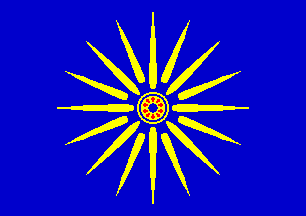
2) the flag with the Macedonian star must be replaced. That symbol is known only in ancient Greek contexts. Perhaps the symbol of Paionia could be the flower named for it: peony.
3) maps used in public places and schools must cease to show a unified “Macedonia” stretching southward to Mt. Olympus and including Thessaloniki.
This prohibition should include such irredentist maps such as that used in an 8th grade history book in 2005 (and perhaps still today), that shows parts of “Macedonia” occupied by Albania (yellow), Bulgaria (purple), and Greece (red).
The use of suggestive commercial devices such as bank notes with the White Tower of Thessaloniki, must be stopped.
The same should be enforced for materials such as coffee sold under the name of Pella – the capital of ancient Macedonia and birthplace of Alexander – with a sailing ship as its symbol. What is implied thereby for a country which has no seaport?
4) The modern statues of Alexander and Philip recently erected by the Skopjean government must be razed. They are an insult to history. Could Alexander have read the Slavic inscriptions on those statues?
Although there will certainly be those in Skopje who will resist such reforms, I believe that they are absolutely necessary if Greece and Paionia are to live in peace. I also believe that the natives of that land would feel a greater sense of security knowing that their identity was not stolen from another.
PS: There is another solution: Greece annexes Skopje.
Originally published on 2018-01-10
About the author: Stephen G. Miller, Professor Emeritus, University of California, Berkeley
Origins of images: Facebook, Twitter, Wikimedia, Wikipedia, Flickr, Google, Imageinjection, Public Domain & Pinterest.
Read our Disclaimer/Legal Statement!
Donate to Support Us
We would like to ask you to consider a small donation to help our team keep working. We accept no advertising and rely only on you, our readers, to keep us digging the truth on history, global politics and international relations.
Romantic nationalism and the BalkansIn the 19th century, Europe witnessed the rise of romantic nationalism, which created contemporary nations.[i] Many European states, based on the concept of ethnicity (common origin, culture, history, language, and tradition), were founded at the time, including the people living in the territories of Serbia, Montenegro, Greece, Bulgaria, Croatia, Slovenia, and Romania. However, a number of contemporary regional nations remained at that time without their national states like Slovenians, Croatians, Macedonians, and Albanians. Some of these nations temporarily solved in the 20th century their national aspirations via common states, like Croats, Slovenians, and Macedonians (within several ...
Such important reality as is shown in this picture is virtually unpublishable in mainstream US ‘news’media, because US ‘news’media need to deceive their public about the most important international realities — such as that the US imposed upon Ukraine a nazi regime against Russia, and the US now lies to accuse Russia for doing what Russia must do in order to protect itself from the US nazi regime next-door.This picture is among many which were originally published in the excellent 4 July 2018 article by Asa Winstanley at The Electronic Intifada. His article was headlined "Israel is arming neo-Nazis in Ukraine”. That article focuses upon Israel’s strong support for ...
America’s war of expansion over Mexico, backed by newspapers and politicians, has repercussions to the present day.Reflecting on his life while dying of throat cancer in 1885, the former US President Ulysses S. Grant said the Mexican-American War was, “the most wicked war in history. I thought so at the time, when I was a youngster, only I had not moral courage enough to resign”.Grant had first-hand experience as he himself fought in the Mexican-American War (1846-1848), then as a junior officer in his mid-20s. Less than two decades later, he rose to prominence as one of the most important ...
Originally published in June 2018.Read our Disclaimer/Legal Statement!Donate to Support UsWe would like to ask you to consider a small donation to help our team keep working. We accept no advertising and rely only on you, our readers, to keep us digging the truth on history, global politics and international relations.Origins of images: Facebook, Twitter, Wikimedia, Wikipedia, Flickr, Google, Imageinjection, Public Domain & Pinterest.
Initially modelled after Hitler’s rapid war-winning strategy, the NATO offensive was not expected to last more than three or four days before Yugoslavia folded. In the event, it lasted more than seventy days.While March 24 passed largely unnoticed in the West, where it should have evoked enormous outpourings of shame and repentance, in Moscow it was remembered by Maria Zakharova who correctly called it “a forever stain on NATO’s reputation.” On that day in 1999, invoking as its the pretext the urgent need to protect from persecution Kosovo’s Albanian minority, the NATO alliance, under the coordinated leadership of major Western ...
In the spirit of the New Cold War and following on its success in snuffing out South Stream, the US has prioritized its efforts in obstructing Russia’s Balkan Stream pipeline, and for the most part, they’ve regretfully succeeded for the time being. The first challenge came from the May 2015 Color Revolution attempt in Macedonia, which thankfully was repulsed by the country’s patriotic citizenry. Next up on the destabilization agenda was the political turmoil that threatened to take hold of Greece in the run-up and aftermath of the austerity referendum, the idea being that if Tsipras were deposed, then Balkan ...
“Fool me once, shame on you; but fool me twice, shame on me.”Ancient proverb, (sometimes attributed to an Italian, Russian or Chinese proverb) “Any intelligent fool can make things bigger, more complex, and more violent. It takes a touch of genius, and a lot of courage to move in the opposite direction.” Ernst F. Schumacher (1911-1977) (in ‘Small is Beautiful’, an essay, in The Radical Humanist, Aug. 1973, p. 22). “The powers-that-be understand that to create the appropriate atmosphere for war, it’s necessary to create within the general populace a hatred, fear or mistrust of others regardless of whether those others belong ...
In an interview for the German news magazine Zuerst! (April 2015) Srdja Trifkovic considers the significance of Otto von Bismarck’s legacy, 200 years after his birth.Dr. Trifkovic, how would Bismarck react if he could see today’s map of Europe?Trifkovic: He would be initially shocked that the German eastern border now runs along the Oder and Neisse rivers. Otto von Bismarck was a true Prussian. In his view, cities such as Königsberg, Danzig or Breslau were more properly “German” than those in the Rhineland. His first impression therefore would be that Germany has “shifted” to the West, and that an important social and ...
PrefaceIt is a very linguistic fact that the term “race” exists in all languages derived from the Latin one. For instance, the meaning of this term is identical in English and French like in some other languages or very similar regarding the meaning. However, the term “race”, basically, refers in all of those Latin derived languages to a group of people who are sharing a common origin. Nevertheless, therefore, the term is not clearly distinguishable from very similar terms of “ethnicity” or “nationality”.[1]Before 1945Historically, it was not up to the mid-19th century that any account of race became to a ...
Having just returned from a trip to Russia, I am pleased to report that the Russian people and the officialdom that I encountered displayed none of the vitriol towards Americans that I half expected as a response to the vilifying of Moscow and all its works that pervades the U.S. media and Establishment. To be sure, many Russians I spoke with were quick to criticize the Trump Administration for its hot and cold performance vis-à-vis the bilateral ties to Moscow while also expressing mystification over why the relationship had gone south so quickly, but this anger over foreign policy did ...
Gibraltar is famous for its 426m high limestone ridge and tax haven status. It is also famous for having Europe’s only wild population of monkeys – all 320 of them. It boasts a total area of just 6.8 square kilometres or 2.6 square miles, a total area approximately one third smaller than Bicester Village Shopping Mall in Oxfordshire. Most of the population of this peninsula live in flats, crammed on land at the base of the rock where around 12% of the workforce is employed by Gibraltar’s big online gaming industry, who are there to evade taxes – quite legally of course. ...
1. Kosovo is not ancient Albanian landIts very name comes from the Serbian word “kos,” meaning blackbird. Its Albanian name, “Kosova,” means nothing whatsoever.Kosovo was the heartland of medieval Serbian state and the site of the 1389 battle in which both the Serbian prince and the Ottoman sultan died, checking the Turkish expansion into the Balkans for almost 70 years. Ethnic Albanians were settled there by the Ottomans over the intervening centuries, and became a majority due to pogroms and persecution of Serbs – which began under Ottoman rule but continued under Austro-Hungarian occupation in WWI and German/Italian occupation in ...
The Balkans conflicts of the 1990s saw a massive revival and resurgence of US and Western media propaganda and infowar techniques. The “new” advocacy journalists recalled the “yellow journalism” of William Randolph Hearst, who helped induce the US to engage in the imperialistic or colonial war in Cuba in 1898, the Spanish-American War. This marked the emergence of the US as an expansionist global imperial and colonial power, like Britain, France, Spain, and Germany had been. Hearst was credited with manufacturing or “furnishing” the war in Cuba.Frederic Remington, his correspondent in Cuba, reported that nothing was happening in Cuba, that ...
“I hate the gooks,” Sen. John McCain (R-AZ) doubled down when asked on the 2000 presidential campaign trail about his continued use of the racist slur for Vietnamese people. “I will hate them as long as I live.” In the mind of the settler-colonialist, the white invader is always the victim and the people he invades, occupies, expels or exterminates are always the aggressors, going all the way back to the Native American genocide. McCain was never able to understand that in Vietnam, as in just about everywhere else they went, Americans were the invaders, not the victims. Even as McCain ...
The present-day Republic of Turkey is a legal successor state of the former Ottoman Empire (Sultanate). The Republic was founded and proclaimed by Mustafa Kemal Atatürk on October 29th, 1923 as a result of the collapse of the Ottoman Empire after the lost WWI. A republican Turkey originally was based on the following six principles:Republicanism – Republic instead of a monarchical sultanate.Nationalism - An aggressive anti-minority policy within the state especially against the Kurds.Populism – It was attended in the atmosphere of the absence of a multiparty democracy to gather as much as popular support for the one-party political system.Statism ...
Donald Franciszek Tusk, (born 22 April 1957) is a Polish politician and historian. He has been President of the European Council since 1 December 2014. Previously he was Prime Minister of Poland (2007–2014) and a co-founder and chairman of the Civic Platform (Platforma Obywatelska) party.Tusk began his public career as an activist in his home town of Gdańsk, supporting Solidarity and organizing his fellow university students. With the exception of one four-year stretch, Tusk has served in the Third Republic Sejm (parliament) continuously since its first elections in 1991. He was Vice Marshal (deputy speaker) of the Senate from 1997 ...
Imagine that Vladimir Putin were not a murderous autocrat and kleptocrat who has spent his fourteen years in power living up to his KGB past and dragging Russia ever back towards Communist autocracy, illiberalism, and expansionism. Imagine that instead he were one of the greatest leaders that Russia has had, whose policies have helped produce a massive rise in living standards and life expectancy, recuperation of national pride, and enforcement of the rule of law, who has tackled kleptocrats and gangsters wisely and well, whose foreign policy has on balance been realistic, diplomatic, and conducive to peace, who has presided ...
Most of former Ukraine is now (since 2014) occupied by nazis/fascists and rasists/extreme nationalists. In some cases they are disguised within other political parties but, make no mistake, their ideology does not change just because they change name or party organisation. As is well known, when the nazis made their coup in 2014 (directed and assisted by the CIA), the first "law" they forcefully passed through the rump and unconstitutional rest-parlament was the prohibition of the russian language (the majority language!) from all official institutions, schools, administration and so on.The second "law" they passed was the legalisation of the nazi ...
There is a reason that most countries polled in December 2013 by Gallup called the United States the greatest threat to peace in the world, and why Pew found that viewpoint increased in 2017.But it is a reason that eludes that strain of U.S. academia that first defines war as something that nations and groups other than the United States do, and then concludes that war has nearly vanished from the earth.Since World War II, during a supposed golden age of peace, the United States military has killed or helped kill some 20 million people, overthrown at least 36 governments, ...
The Balkan Peninsula, together with the region of South-East Europe, historically has been one of the most important focal points of Russian foreign policy, cultural influences and attempts to spread an ideology of Orthodox solidarity and Slavic reciprocity.[1] These ideas are common to almost all trends of Russian public life in the past and very much today too.After Russia lost the Great Crimean War of 1853–1856 she intensified its cultural influence in the region of South-East Europe for the purposes of beating Habsburg (Roman-Catholic) rivalry and to spread an idea of the Pan-Slavism in this part of Europe.[2] However, the ...
The magazine is covering the research gaps uncovered by global Western hoax mainstream media platforms and academic teaching & research institutions.
This is an alternative information & academic research digest platform with the purpose to offer an alternative “another side of the truth”.
The magazine is independent, private, and free of any influence by any institution, organization, government, or pressure group. URL: www.global-politics.eu