
Genocide in the Ottoman Empire: Armenians, Assyrians, and Greeks, 1913-1923
Asia Minor and Pontos Hellenic Research Center Announce new book about genocide in the Ottoman Empire on Armenians, Assyrians, and Greeks, 1913-1923 [...]
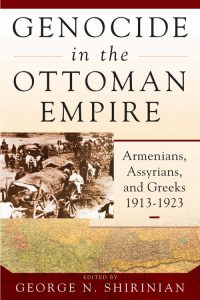
The Asia Minor and Pontos Hellenic Research Center is pleased to announce a new book, Genocide in the Ottoman Empire: Armenians, Assyrians, and Greeks, 1913-1923. Edited by George N. Shirinian. New York and Oxford: Berghahn Books, 2017. 433 pages.
The final years of the Ottoman Empire were catastrophic for its non-Turkish, non-Muslim minorities. From 1913 to 1923, its rulers deported, killed, or otherwise persecuted staggering numbers of men, women and children in an attempt to preserve “Turkey for the Turks,” setting a modern precedent for how a regime can commit genocide against its own citizens in pursuit of political ends, while largely escaping accountability. While this brutal history is most widely known in the case of the Armenian Genocide, few today appreciate the extent to which the fate of the Empire’s Assyrian and Greek subjects was intertwined with that of the Armenians. The US Ambassador to the Ottoman Empire, Henry Morgenthau, stated that
The Armenians are not the only subject people in Turkey which have suffered from this policy of making Turkey exclusively the country of the Turks. The story which I have told about the Armenians I could also tell with certain modifications about the Greeks and the Syrians. Indeed, the Greeks were the first victims of this nationalizing idea … In fact, Bedri Bey, the Prefect of Police at Constantinople, himself told one of my secretaries that the Turks had expelled the Greeks so successfully that they had decided to apply the same method to all the other races in the empire.
One of the chapters examines the legal basis for treating the partial destruction of a group by deportation as genocide and concludes that there is important evidence of genocidal intent to be found in the strains of extremist ideology that emerged in the Ottoman Empire during the last quarter of the nineteenth century and first quarter of the twentieth century. This is especially relevant today, with the extermination and depopulation of Assyrians and Yezidis in the Middle East resurfacing through the extremist ideology and actions of the Islamic State since 2014. Studying the genocides of the Ottoman Empire can help us better contextualize and understand contemporary identity-based violence in the region today, and hopefully offer insights into how to recognizeand prevent current or future crimes against humanity.
This comprehensive volume is the first to broadly examine the genocides of the Armenians, Assyrians, and Greeks in a holistic manner,providing detailed descriptions, careful analysis, and essential context. Five of the studies in this collection are comparative in nature.The text is rich in quotations of original source material and fully annotated. It includes previously unpublished photographs and documents. The contents and contributors are listed below.
This book has its origins in the “International Conferenceon the Ottoman Turkish Genocides of Anatolian Christians,” held at the IllinoisHolocaust Museum and Education Center in May 2013, co-organized by the AsiaMinor and Pontos Hellenic Research Center, the Armenian National Committee, andthe Assyrian Center for Genocide Studies. Itis the latest in a series of activities that are partof the long-term effort of the AMPHRC to promote the study of the larger pattern of genocide in the late OttomanEmpire and early Turkish Republic and to raise awareness of it
The AMPHRC is a not-for-profit, 501(c)(3) organization established in January 2011. The Center’s goal—unique in its kind—is to document and raise awareness of the “Great Catastrophe” that resulted in the uprooting and destruction of the Greek communities in their homelands of Asia Minor, Pontos, and Eastern Thrace in the early decades of the twentieth century after a 3,000-year-long presence there.
This is a “must-have” book for those with an interest in Armenian, Assyrian or Greek History;Late Ottoman and Turkish Republican History; the History of the Modern Middle East; Genocide and Comparative Genocide Studies; Political Science;and Sociology.
George N. Shirinian is Executive Director of the International Institute for Genocide and Human Rights Studies (A Division of the Zoryan Institute). His book publications include Studies in Comparative Genocide(Macmillan 1999) and The Asia Minor Catastrophe and the Ottoman Greek Genocide: Essays on Asia Minor, Pontos, and Eastern Thrace, 1913–1923 (Asia Minor and Pontos Hellenic Research Center 2012). His articles include “Turks Who Saved Armenians: Righteous Muslims During the Armenian Genocide,” and “Starvation and its Political Use in the Armenian Genocide” (forthcoming). The 14 contributors represent specialists on Armenian, Assyrian and Greek history, Genocide Studies, and International Criminal Law. They conduct research and teach in Armenia, Australia, Greece, and the United States.
Contents:
List of Illustrations Preface
Introduction George N. Shirinian
PART I: CONTEXTS
Chapter 1. The Background to the Late Ottoman Genocides George N. Shirinian
Chapter 2. Convulsions at the End of Empire: Thrace, Asia Minor, and the Aegean Dikran Kaligian
Chapter 3. Assyrians in the Ottoman Empire and the Official Turkish Policy of Their Extermination, 1890s-1918 Anahit Khosroyeva
PART II: DOCUMENTATION AND EYEWITNESS ACCOUNTS
Chapter 4. Considering Genocide Testimony: Three Case Studies Paul Bartrop
Chapter 5. The Assyrian Issue 1914-1935: Australian Documents and Press Stavros Stavridis
Chapter 6. American Women, Massacres, and the Admiral: Deep in Anatolia during the Turkish Nationalist Revolution Robert Shenk
Chapter 7. Found in Translation: Eyewitness Accounts of the Massacres in Nicomedia as Reported by Greek Journalist Kostas Faltaits Eleni Phufas
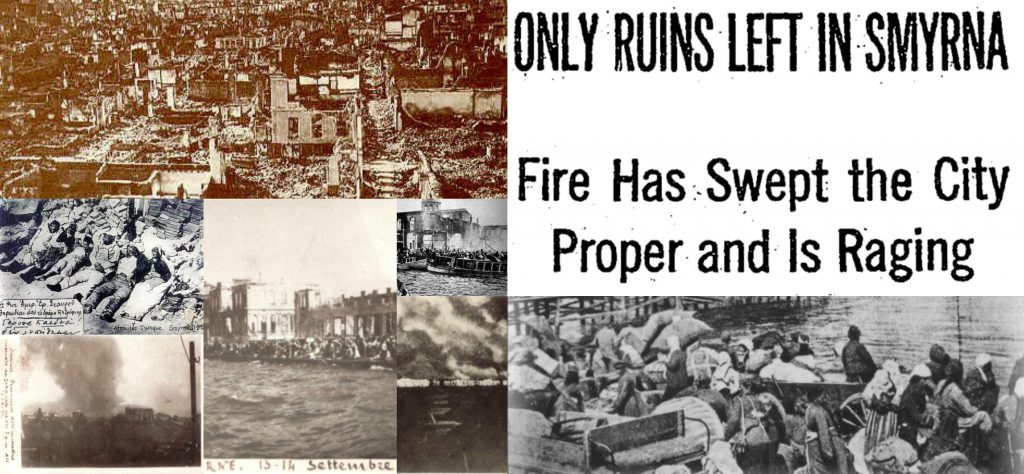
Chapter 8. The Destruction of Smyrna in 1922: An Armenian and Greek Shared Tragedy Tehmine Martoyan
PART III: LEGACIES AND INTERPRETATIONS
Chapter 9. Lemkin on Three Genocides: Comparing His Writings on the Armenian, Assyrian and Greek Genocides Steven Leonard Jacobs
Chapter 10. The Ottoman Genocide of the Armenians and Greeks: The Similarities and Structural Peculiarities Gevorg Vardanyan
Chapter 11. The Genocide of the Ottoman Greeks 1913-1923: Myths and Facts Thea Halo
Chapter 12. Redeeming the Unredeemed: The Anglo-Hellenic League’s Campaign for the Greeks in Asia Minor Georgia Kouta
Chapter 13. Genocide by Deportation into Poverty: Western Diplomats on Ottoman Christian Killings and Expulsions, 1914-1924 Hannibal Travis
Chapter 14. The Socio-Psychological Dimension of the Armenian Genocide Suren Manukyan
Bibliography Index
Origins of images: Facebook, Twitter, Wikimedia, Wikipedia, Flickr, Google, Imageinjection, Public Domain & Pinterest.
Read our Disclaimer/Legal Statement!
Donate to Support Us
We would like to ask you to consider a small donation to help our team keep working. We accept no advertising and rely only on you, our readers, to keep us digging the truth on history, global politics, and international relations.
PrefaceThe “Macedonian Question” is today actual for several reasons of whom two are of the fundamental importance: 1. The Albanian secession in the FYROM; and 2. The Greek dispute with the FYROM authorities over several issues.[1] For the matter of illustration, for instance, Greece is so far blocking Macedonia’s joining NATO and the EU because of an on-going dispute between the FYROM and Greece. The main disputable issue is the title of “Macedonia” used in the country’s Constitution in the form of the official state-name as the Republic of Macedonia.[2] When the ex-Yugoslav Socialist Republic of Macedonia voted for independence ...
In examining the future, we must look to the past.As we watch the media today, we are spoon fed more and more propaganda and fear of the unknown, that we should be afraid of the unknown and have full faith that our government is keeping us safe from the unknown. But by looking at media today, those of us who are old enough will be reminded of the era of Cold War news articles, hysteria of how the Russians would invade and how we should duck and cover under tables in our kitchens for the ensuing nuclear war.Under this mass ...
The wars in the Middle East continue to rage unabated. Over the weekend a Russian war plane was struck down by an Al Qaeda affiliated group, Hayat Tahrir al-Sham, and once again stoked fears of widening the struggle in Syria between US and Russian proxy forces. It is yet another reminder of the ongoing and seemingly endless wars being waged in the Middle East, Africa and elsewhere around the globe.Our transition into this never-ending war paradigm, fashioned out of the events of the post 9/11 era, seeks only to benefit and further cement the pre-existing alliance between the US military ...
It is now September 2016, just two months before the Presidential elections, and both political camps have already managed to disgust a great number of the US voters, by offering almost no comprehensive political or economic program, by offering… close to nothing!While Donald Trump is lashing out at the ‘enemy within’, during his dark moments that are increasingly resembling an advanced stage of delirium tremens (complete with a mad chase after white mice and promises to cleanse society from some imaginary and filthy rapists and social benefits guzzlers, that are constantly pouring from the south), Ms. Clinton is saddling her ...
Backdrop To The BalkansThe tiny South-Central Balkan country of the Republic of Macedonia is in dire straits right now, but most of Europe – let alone the rest of the world – has no idea that this is the case because the Mainstream Media narrative is that the state’s two-year-long political crisis was “resolved” when the patriotic VMRO-DPMNE government of Nikola Gruevski was replaced in a “constitutional/electoral coup” that followed Color Revolution and even Hybrid War provocations. The author wrote about this in a Sputnik piece at the time from May 2017 titled “The Macedonian Crisis Isn’t Over, and a ...
Hannibal Travis, "On The Centenary of The Greek Genocide", AHIF Policy Journal, American Hellenic Institute Foundation, Inc., Vol. 8, Spring 2017, pp. 14Origins of images: Facebook, Twitter, Wikimedia, Wikipedia, Flickr, Google, Imageinjection & Pinterest.Read our Disclaimer/Legal Statement!Donate to Support UsWe would like to ask you to consider a small donation to help our team keep working. We accept no advertising and rely only on you, our readers, to keep us digging the truth on history, global politics and international relations.
Read more about the magazine at:IMPRESSUMPublish and AdvertisePublish your articles on global politics online & advertise your website for a moderate fee on our website.Donate to Support UsWe would like to ask you to consider a small donation to help our team keep working. We accept no advertising and rely only on you, our readers, to keep us digging the truth on history, global politics, and international relations.Join the debate on our social platforms.
There have been at least two countries in Europe in recent history that undertook ‘anti-terrorist’ military operations against ‘separatists’, but got two very different reactions from the Western elite.The government of European country A launches what it calls an‘anti-terrorist’ military operation against ‘separatists’ in one part of the country. We see pictures on Western television of people’s homes being shelled and lots of people fleeing. The US and UK and other NATO powers fiercely condemn the actions of the government of country A and accuse it of carrying out ‘genocide’ and ’ethnic cleansing’ and say that there is an urgent ...
A famous German journalist Dr. Udo Ulfkotte is speaking about Western media propaganda against Russia, orchestrated Western media Russophobia, Western false flags, and fake news about Ukraine, and other things related to global politics.Origins of images: Facebook, Twitter, Wikimedia, Wikipedia, Flickr, Google, Imageinjection, Public Domain & Pinterest.Read our Disclaimer/Legal Statement!Donate to Support UsWe would like to ask you to consider a small donation to help our team keep working. We accept no advertising and rely only on you, our readers, to keep us digging the truth on history, global politics, and international relations.
Muslim populated states of the South-East Europe are the reservoirs of the ISIL Jihadist fighters in the Middle East: Albania, Macedonia, Kosovo, Bosnia. All of these states are the marionettes of the US. This road map was originally published with the article in one Albania's newspapers in Tirana in October 2015Origins of images: Facebook, Twitter, Wikimedia, Wikipedia, Flickr, Google, Imageinjection, Public Domain & Pinterest.Read our Disclaimer/Legal Statement!Donate to Support UsWe would like to ask you to consider a small donation to help our team keep working. We accept no advertising and rely only on you, our readers, to keep us ...
The Consequences of WWI and the YugoslavsThe end of WWI in November 1918 as a consequence of the military collapse of the Central Powers and the following series of peace treaties of Versailles on June 28th, 1919 between the Allies and Germany, of St Germain on September 10th, 1919 with Austria, of Neuilly on November 27th, 1919 with Bulgaria, and finally of Trianon on June 4th, 1920 with Hungary, produced major border changes in Central, South-East, and East Europe as the continent saw the emergence of several of new states and the enlargement of others fortunate enough to be on ...
Editor’s note: This article was originally published in 2014.On Monday [October 13 2014], America’s government offices, businesses, and banks all grind to a halt in order to commemorate Columbus Day. In schools up and down the country, little children are taught that a heroic Italian explorer discovered America, and various events and parades are held to celebrate the occasion.It has now become common knowledge amongst academics that Christopher Columbus clearly did not discover America, not least because is it impossible to discover a people and a continent that was already there and thriving with culture. One can only wonder how ...
"The West" is the nations that are essentially controlled, basically dictated-to, by America's approximately 600 billionaires, who control the U.S. Government, by coordinatedly funding (through their news-media and political donations, and also by their members-only private conferences) the careers of cooperative politicians, and who thereby defeat the politicians who act against increasing the percentage of the nation's wealth that these few people hold, and against increasing their extractions from everybody else. (Those non-compliant politicians are derisively called "socialists" and equated with the communist Joseph Stalin instead of with the democratic socialist FDR and the leaders of the democratic socialist Scandinavian ...
Fighting against the U.S. Corrupted Administration: Chronology of Events in the Case of Ronald Thomas WestRepublished by permission by the author.Origins of images: Facebook, Twitter, Wikimedia, Wikipedia, Flickr, Google, Imageinjection & Pinterest.Read our Disclaimer/Legal Statement!Donate to Support UsWe would like to ask you to consider a small donation to help our team keep working. We accept no advertising and rely only on you, our readers, to keep us digging the truth on history, global politics and international relations.
Unfathomable as that may appear, yes, it was quite possible for the second-ranking slaughterhouse in Europe in recent memory to have slipped off the radar screen. Even such a renowned authority as Professor Gideon Greif is having an exceptionally difficult time of it in trying to put it back on.Precisely because it has not been the theme of any Hollywood spectaculars, Jasenovac does not attract any school excursions and textbooks are largely silent about it. Some background information on Jasenovac therefore seems like a good place to start.The Jasenovac death camp (1941 – 1945) is inextricably bound up with the ...
Russian professor, Doctor of History Sergey Perevezentsev has touched upon a hidden historical and political motive of the scandal caused by the speech of the Patriarch Kirill of Moscow at the celebration of Bulgaria's liberation from Ottoman oppressors.It would seem that Bulgarian President Rumen Radev said everything correctly in his speech - he called to keep memory of the warriors of many nations killed on the fields of those old battles: Russians, Romanians, Finns, Ukrainians, Belarusians, Polacks, Lithuanians, Serbians and Montenegrins. "Historical tolerance" is preserved, and principle of "multiplicity of truths" is not broken.However, as the historian explained, in 1874 ...
On 23 June 2017 in the Parliament Square of Vilnius, capital of Lithuania, an official celebration of the uprising of 23 June 1943 against Soviet rule took place. The event was orchestrated mainly by veterans of the Lithuanian Freedom Fighters Association, a far-right militia group. During these celebrations an exhibit of more than 12 posters were hung which presented the anti-Soviet insurrection one that “drove terror into the Bolshevik occupying army and the lackeys of the occupation forces.”Some historical context is needed here.In June 1941, Hitler had launched a surprise attack on the Soviet Union, overrunning the Baltics in a ...
Originally, the Bush Doctrine was a political phrase with the aim to describe the US foreign policy goals during the 43rd US President George W. Bush (Bush Junior), 2001−2009. The doctrine had four basic standpoints. All of them were centered around American military superiority after the Cold War 1.0 as the US being the only global hyperpower in international relations.The Bush Doctrine's fundamental standpoints The fundamental standpoints of the Bush Doctrine are: 1) Unilateralism; 2) A logic of “either with us or with the terrorists”; 3) Pre-emption; and 4) Regime change.It must be noted that the Bush Junior administration turned ...
The reason why the U.S. Government must be prosecuted for its war-crimes against Iraq is that they are so horrific and there are so many of them, and international law crumbles until they become prosecuted and severely punished for what they did. We therefore now have internationally a lawless world (or “World Order”) in which “Might makes right,” and in which there is really no effective international law, at all. This is merely gangster “law,” ruling on an international level. It is what Hitler and his Axis of fascist imperialists had imposed upon the world until the Allies — U.S. ...
On January 5th, a very interesting online conference and debate with experts regarding the current Ukrainian crisis was held. The information presented in the debate is very interesting for anyone dealing with the Ukrainian crisis and European policy towards the crisis.Hansjörg MÜLLER (former member of Bundestag from AfD): Training soldiers makes Germany participant of the war. A Bundestag council stated that Russia would be right if attacking Germany in the framework of international law, because Germany started participating in anti-Russian aggression. Treating Ukrainian soldiers in German hospitals is a good sign of humanity. Sending weapons and training soldiers has nothing ...